Chapter 1

Picturing Rhetorical Education

James Warwood (coauthor)
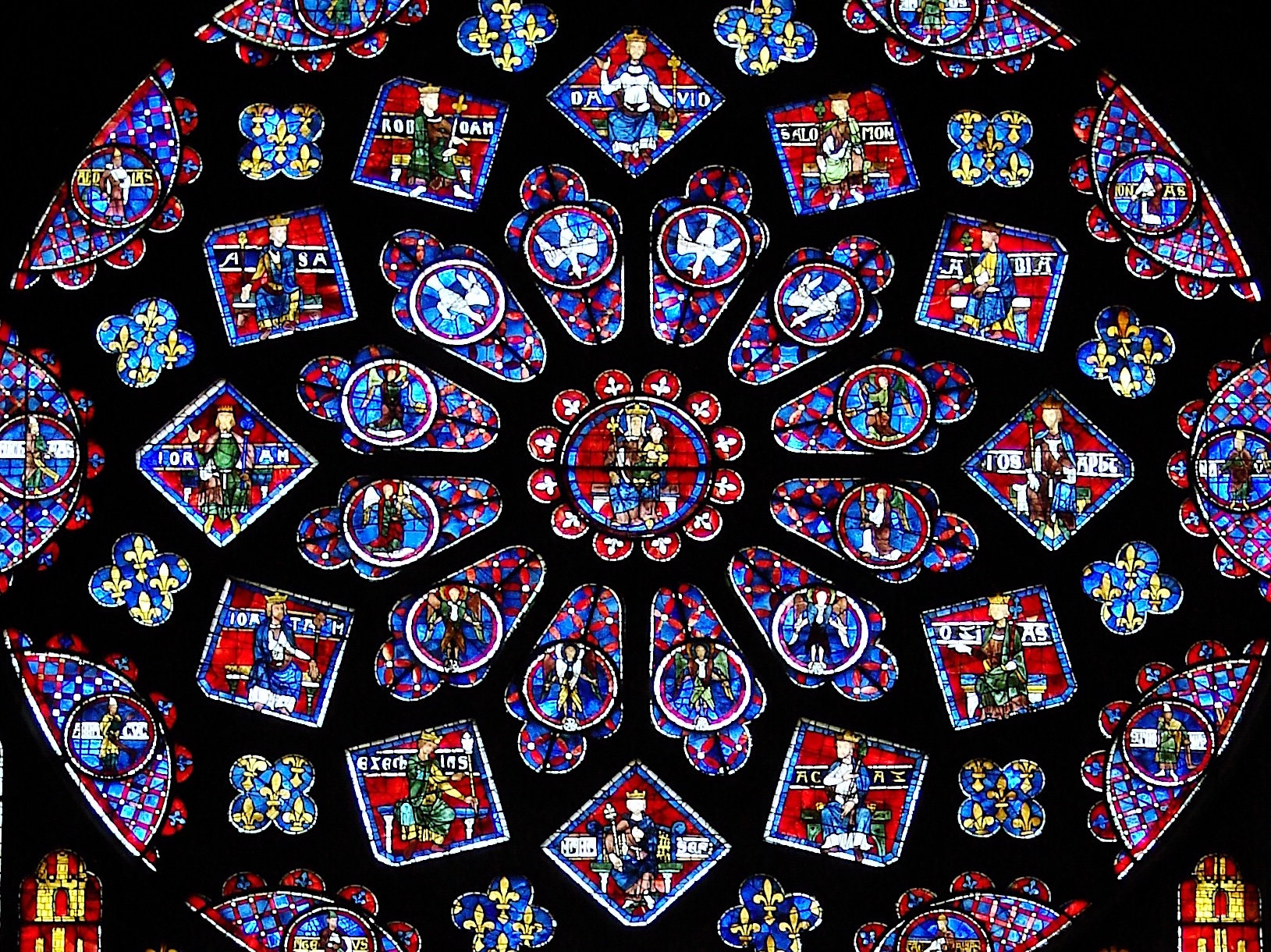
Photograph of a stained class window

Figure 5. The North Rose Window, Chartres Cathedral, August 4, 2007. Photograph. Flickr. Allie Caulfield.

Teaching—across all forms and media—has long been recognized as a basic function of rhetoric. Jeffrey Walker, in The Genuine Teachers of this Art: Rhetorical Education in Antiquity, puts it quite forcefully: “Its pedagogical enterprise is what ultimately makes rhetoric rhetoric and not just a version of something else.”1 Walker is focused on a traditional notion of rhetorical education—the specific tasks of teaching oratory and writing—and he emphasizes “the cultivation of rhetorical capacity” as the center of rhetoric’s pedagogical function.2 We expand his frame, noting that all teaching carries rhetorical force, not just instruction meant specifically to enhance speaking and writing skills. “The cultivation of rhetorical capacity,” therefore, can take many forms and be a factor across many educational contexts. Indeed, Jens E. Kjeldsen makes just such an argument about teaching visual rhetorical capacity, emphasizing the ability to “decode visual communication” and also the means “to interpret and evaluate it” through “critical thinking…situational and cultural knowledge…[and] sound judgment.”3

For Walker, Kjeldsen, and most other rhetorical educators, the work of instruction involves not only teaching new information but teaching that information with purpose. The knowledge generated through teaching and learning, combined with subsequent uptake of that knowledge, inevitably shapes the understandings, beliefs, and actions of everyone engaged in the educational enterprise, including teachers and students. All those learners leave the classroom equipped with new rhetorical capacities.

In classical Western frameworks, this pedagogical function of rhetoric has often been aligned with the deliberative branch of rhetoric—not identical but resonant—because both deliberation and rhetorical education are oriented toward imagining and changing the future. They also both assume that exchanging ideas and building knowledge ought to lead toward a common good. Arabella Lyon writes that to deliberate is “to recognize interlocutors, to comprehend their competing claims, and to weigh definitions of the issue and the consequences of their decision.”4 Likewise, the value of rhetorical education is typically defined in terms of building capacity to engage with others in shaping the life of their community. As Jessica Enoch notes, this belief that education carries civic purpose has remained a commonplace of rhetorical study from the Western classical period to the present.5 The ancient Greek sophist Isocrates advocated for rhetorical education on the presumption that it would “enable [students] to govern wisely both their own households and the commonwealth”—a foundational framing that directly links rhetoric’s deliberative and educational functions and ties them to public or civic benefit.6 It combines with an equally longstanding sense that cultivating citizenship is a core responsibility for rhetorical educators, thereby linking teaching and deliberation as essential activities of both public life and the field of rhetorical studies. From a Western rhetorical perspective, sites of education—across pedagogical styles and eras—are therefore also often sites of deliberation.

This deep commitment to teaching and learning as public-making projects has infused much scholarship in visual rhetoric, and it has shaped the available heuristics for naming what the visual does, rhetorically.7

In this chapter

We elaborate that pedagogical function of visual rhetoric. We show how Western rhetorical theories connected with the visual have, across centuries, understood the visual as shaping communities by teaching new information, new relations, and new orientations to public life. And, we illuminate how sustained attention to those combined pedagogical and deliberative aspects of visual rhetoric has shaped broader understandings of what visual rhetoric is and does. While our discussion ranges across centuries, we focus it through a particularly resonant representative anecdote: the use of visual imagery in medieval and early modern Christian religious education, particularly the famous stained-glass windows of the Cathedral in Chartres, France, built during the twelfth and thirteenth centuries.

Deliberating Religious Rhetorics


In the millenia since the authors of the Greek New Testament drew extensively on Aristotelian theories to frame their appeals to the early Christian church, the study of rhetoric has become increasingly secular.8 It may seem strange, therefore, to frame a discussion of public deliberation and civic education through medieval religious visual theories and the windows of a cathedral. In the contemporary United States, after all, while education and deliberation remain associated with civic life, institutionalized religion is not. However, as numerous rhetorical scholars have shown, the present secular presumption is historically recent and, even today, it leaves a great deal of deliberative activity out of the picture.9 It also, notably, whitens the history of rhetorical education in the United States.10 Until at least the mid-nineteenth century, moreover, rhetorical education in Europe and the United States had strong ties to religious education and religious professions. And, starting in the medieval period in Europe, religious education for the laity was deeply informed by theories of vision, what Paul Crossley calls “the Gregorian principle of learning by seeing.”11 For our purposes, we find that turning to the now less familiar realm of sacred rhetorical pedagogy and deliberation helps us better illuminate both the utility and the limitations of the rhetorical functions of the visual that are associated with them.

A photograph looking up at Chartres Cathedral from between two buildings.

Figure 12. Exterior of Chartres Cathedral. August, 21, 2022. Photograph. Unsplash. Mathias Reding.

In addition, this example helps us draw out an important tension that scholars of rhetorical education and deliberation have long highlighted: both deliberation and rhetorical education have a tendency, as Nan Johnson explains, to “maintain rather than destabilize status-quo relationships of gender, class, and race.”12 While deliberative education is not inherently normative, anyone working in the realm of deliberative rhetoric must grapple with its ties to hegemonic institutions and its presumption that deliberation most often happens within the halls of power. Rhetorical education, likewise, while not necessarily constrained to formal schooling, was built into the structures of establishment education in the West over centuries.13 Turning to a Catholic cathedral, a site that was explicitly built to channel such power through multiple modes—the aural, spatial, and visual notable among them—gives us an especially rich scope to detail the pedagogical and deliberative functions of the rhetorical in its full potency and shed light on its use across contexts.

In pre-Reformation Europe, the Catholic Church was a major rhetorical force. Its institutional structures often enabled and constrained both individual and communal action. Religious elites were major players in the politics of the time (Michael Camille, for example, notes “God’s expanding business among the rising urban communities of the thirteenth century”).14 The Church was also a primary source of rhetorical education for people at all levels of society. Its cultural ubiquity and civic influence make the visual rhetorics of the Catholic Church an ideal representative anecdote for what we’ll call the “pedagogical-deliberative functions of the visual.” These functions include widely recognized rhetorical activities, and they imagine the visual wielding intellectual, bodily, and emotional force. In the remainder of this chapter, we treat the pedagogical-deliberative functions of the visual in three sections, first highlighting the role of images in shaping public life, then treating their contributions to various theories about instruction of minds, bodies and souls, and finally—crossing from medieval Europe to colonial New Spain—considering the violence undergirding even an attenuated version of the pedagogical-deliberative function’s subject-making force.

Learning to Picture Public Life


The pedagogical-deliberative functions of the visual name what may seem a truism: pictures teach. From picture books for toddlers to medical illustrations aimed at graduate students, twenty-first-century viewers are accustomed to the idea that pictures are a useful medium for sharing information and shaping understanding. Even though theories of visual effect have changed significantly over the centuries, this recognition of visual information-transmission has a long history. So does the idea that there is something more than just information transmitted through visual encounters—that teaching with images has designs on individual actions and public life.

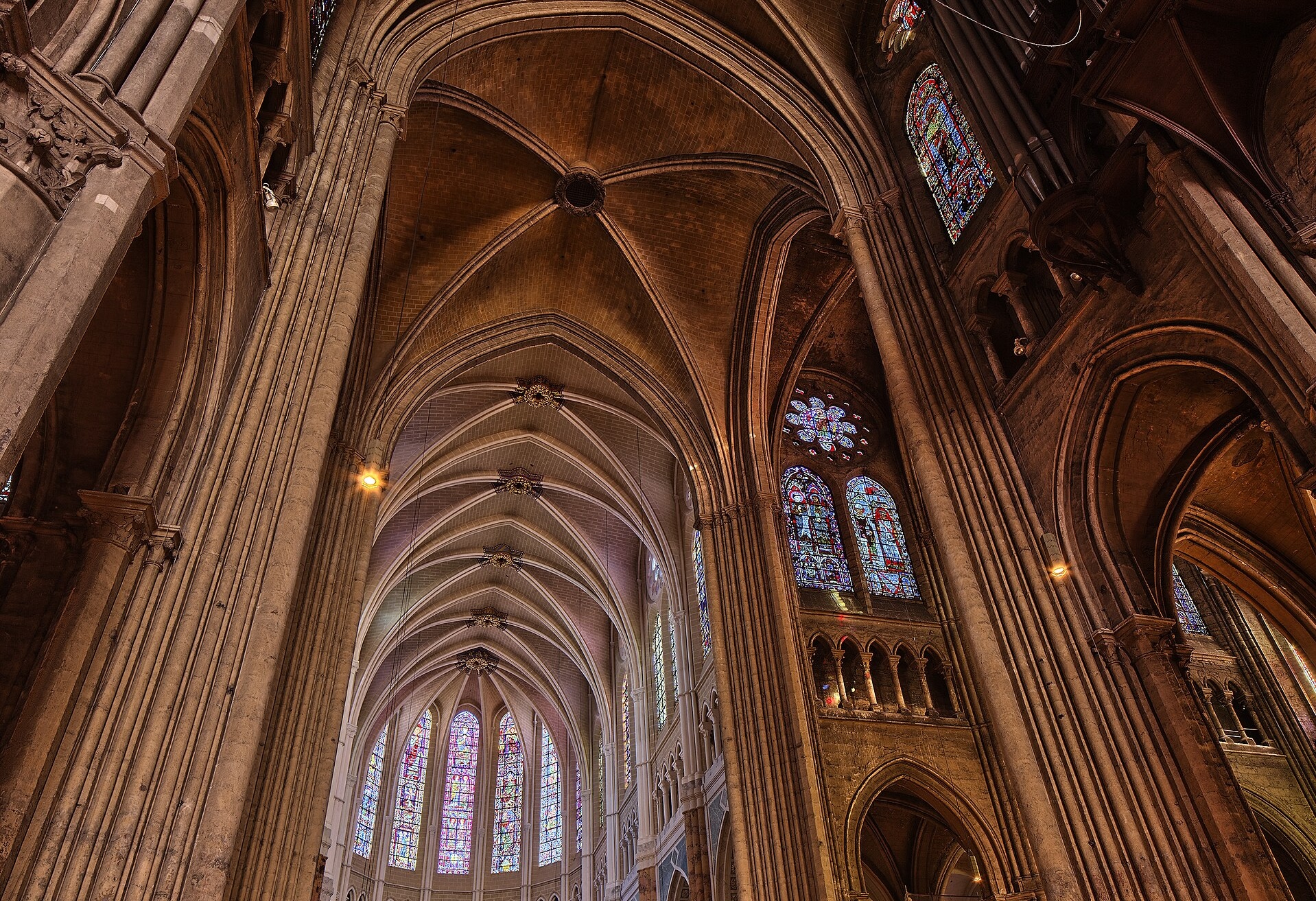
 A photograph taken at an upward angle of the vaulted ceiling of Chartres Cathedral.

Figure 13. Interior of Chartres Cathedral. January 14, 2012. Photograph. Wikimedia Commons. MMensler.

Pictures’ pedagogical heft—and their public effects—have, historically, been the subject of much interest and anxiety in Western contexts. Both reactions (the interest and the anxiety) grow out of visual education’s habitual association with mass education. Put simply, pictures teach the people. And—it is commonly, though erroneously assumed—they do that teaching more easily and effectively than words do.15 When pictorial pedagogy for the masses intersects with public life, it tends to prompt either concern or enthusiasm from institutional elites, depending on how much control they imagine themselves having over the pictures and their messages. In the twentieth and twenty-first centuries, for example, this contrasting impulse can be seen in—on the one hand—widespread investment in educational television, training films, and museums, and—on the other—congressional hearings about video game violence, parental fear in the face of deadly viral memes, and efforts to contain the proliferation of pornography.

This tension—and the related arguments about pictures’ public role—emerge precisely because of the links between rhetorical education and public life and, by extension, commonplace beliefs about the pedagogical-deliberative functions of the visual. Both the hope that seeing something will teach necessary information about it and the fear that out-of-control images will lead to an out-of-control society presume that what pictures teach has direct implications for how well (or badly) a community will function. Public writing about the visual often invokes this idea of the pedagogical-deliberative function of the visual, citing pictures’ capacity to teach everyday people about histories or experiences that might otherwise seem distant.16 Rhetoricians working with the visual have, likewise, frequently sought to make sense of both this function and the popular theories that lend it strength. Their analyses have challenged presumptions about how pictures work and redefined fundamental rhetorical concepts.

Rhetoricians working in this vein have complicated “iconophobic” presumptions that treat pictures as particularly risky teachers. Cara Finnegan and Jiyeon Kang offer one such rethinking, calling for more nuanced treatments of how pictures circulate in public life.17 Some scholarship in this vein grapples directly with pictures’ reputation for bad influence either by engaging it explicitly18 or by holding up more positive examples of pictures’ pedagogical and/or deliberative work.19

Scholarship treating the visual’s pedagogical and deliberative functions has often taken up rhetorical concepts long presumed to be specific to language and expanded them in light of the visual’s affordances. The long scholarly conversation about whether and how pictures argue, for example, ultimately catalyzed a shift in argumentation studies’ assumptions about not only the textual basis of argument but also its inherent rationality.20 Rhetoricians have likewise tackled the fear that mass media images might degrade public life and, in the process, they have redefined key terms like the “public sphere” and even deliberation itself.21

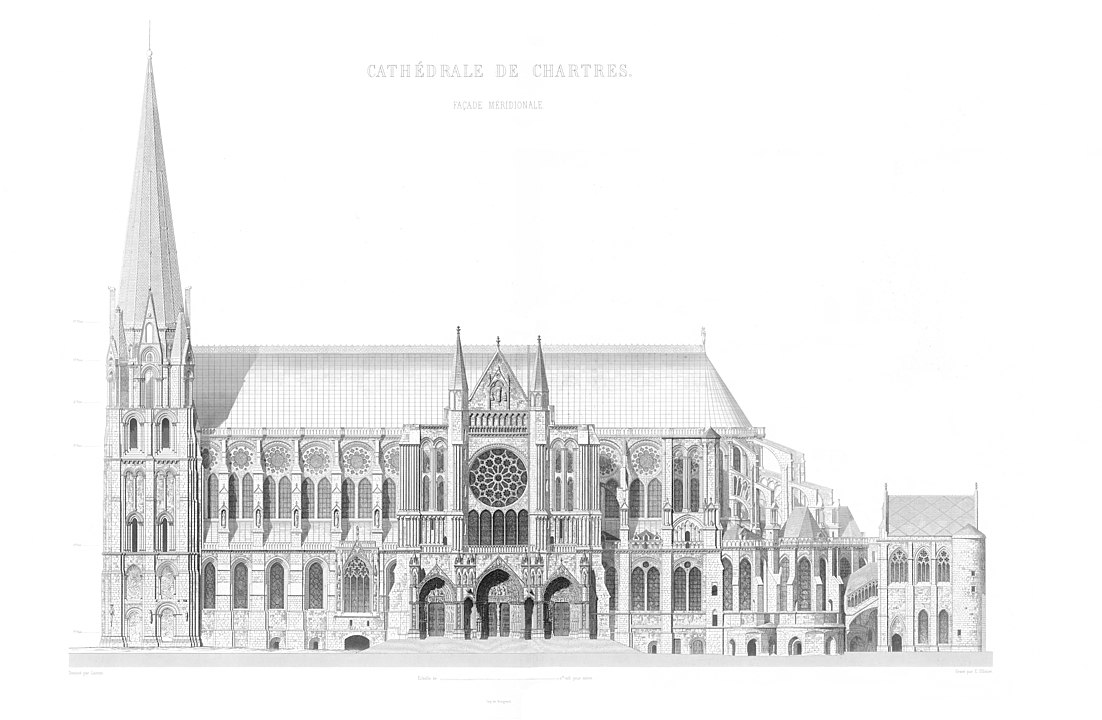
A detailed black and white sketch of the south side of Chartres Cathedral.

Figure 14. Sketch of Chartres Cathedral, South Elevation, 1867. Image. Monographie de la cathédral de Chartres.

Centuries earlier, scholars in Medieval Europe also sought to understand the persuasive power of pictures in public life, offering theories of visual persuasion that understood images as guides and treated them as rhetorical actors.22 Although verbal preaching and teaching were primary means of both elite and lay religious education during the medieval period, Christian religious pedagogy also took visual and spatial form. Paul Crossley notes that medieval religious education “trained understanding, memory and contemplation…by visual means” and emphasizes that “the conflation of memory with visual aids…opened up the possibility for art, at first in the…monastery, and then in the public and lay forum of the cathedral, to assume a vital role in the ordering, contemplating, and memorizing of encyclopaedic truth.”23 This visual religious education was explicitly rhetorical in character, Crossley explains, writing that “to instruct, impress, and stimulate contemplation”—“the famous formulation of the purposes of Christian art, attributed to Thomas Aquinas,” is clearly an adaptation of “Cicero’s classic definition of rhetoric: to instruct, to delight, to move.”24 The Medieval approach to visual education in Christian faith was not only profoundly tied to theories of rhetoric, in other words, it also directly engaged the pedagogical and deliberative purposes of rhetoric—with instruction at the forefront.

Mary Carruthers argues that Medieval visual theories understood the rhetorical power of pictures in terms of ductus—quite literally a theory of visual display as a guide or practical teacher. Ductus referenced “the way by which a work leads someone through itself: that quality in a work’s formal patterns which engages an audience and then sets the viewer or auditor or performer in motion within its structures.”25Ductus” Carruthers further explains, “is the way(s) that a composition, realizing the plan(s) set within its arrangements, guides a person to its various goals, both in its parts and overall.”26 This understanding of how pictures moved viewers led to Medieval Christian art and other visual forms being incorporated into everyday religious life as sources of rhetorical education. They were intended to guide viewers into proper Christian behavior.

Although monasteries began as cloistered sites of religious contemplation, they eventually became sites of pilgrimage. Recognizing a new audience, religious leaders developed religious education specifically for lay visitors. Likely informed by the idea of ductus, this religious training often took visual form, including in the sculpture and stained glass that were incorporated in religious architecture. Scenes depicting well-known stories provided a visual narrative via which visiting pilgrims could be led to greater understanding of Christian faith and life. With stained glass, a monk would guide pilgrims through the monastery church narrating the parables as the guests gazed at the windows above them. His words not only described the pictures but also gave them purpose and invited the pilgrims to carry that purpose with them as part of their religious experience as they returned home.27 Their physical movement and visual apprehension, combined with the teaching provided by their guide, was expected to align bodies, minds, and souls along the right path of Christian life—a literal embodiment of ductus and of the pedagogical-deliberative rhetorical functions of the visual.

As towns grew up around the monasteries and parish churches joined the monastery churches, stained glass appeared there too. The windows operated in tandem with the messages offered by liturgy, spatial arrangement, art, and the relics and other objects that made a given church into a site of pilgrimage.28 Chartres Cathedral took this mission to its apex in Medieval Europe, and its stained glass windows carried forward that project of religious pedagogy and community shaping with unrivaled energy. In window after window, the right action of Biblical figures, the right action of the local community, and the right action of more recent religious exemplars intertwined, designed to serve as models for viewers to emulate and future generations to admire.

Teaching Minds, Bodies, and Souls


In many of the mid-twentieth century articles that first called attention to visual rhetoric, even when pictures were presented as intervening in public life and serving pedagogical ends, they were also placed in opposition to the most valued elements of deliberation—particularly the use of reasoned and well-warranted argument. The rhetoricians who first treated protests and social movement rhetorics as forms of rhetoric, for example, did so because they realized their orientation toward logical deliberation within existing political structures was too limited. It had resulted in them being unprepared to discuss the more varied forms of public rhetoric that emerged in the 1960s and 1970s.29 Many of those scholars, however, maintained some skepticism about the embodied, visual rhetorical modes they were studying, connecting them with less-valued emotional means of persuasion or coercive tactics and treating them as different from the logical appeals of rational deliberation. Over time, though, what began as grudging anxiety about non-verbal, non-rational rhetorical modes led eventually to a larger disciplinary shift toward understanding rhetoric, its functions, and its effects in deeply embodied terms.30

The pedagogical-deliberative functions of the visual as understood by contemporary rhetorical scholars have—for the most part—fully absorbed this multisensory, embodied sense of what rhetoric is. The rhetorical education offered by pictures and through sight is therefore figured as engaging both the mind and the rest of the body. It is shared with others through bodily comportments, affects, and feelings as well as through words formed by mouths and hands.31 This understanding of the pedagogical-deliberative function is also visible in scholarship that focuses on the political effects wrought by processes of visual production and circulation rather than analyzing the meaning and force of the pictures themselves.32

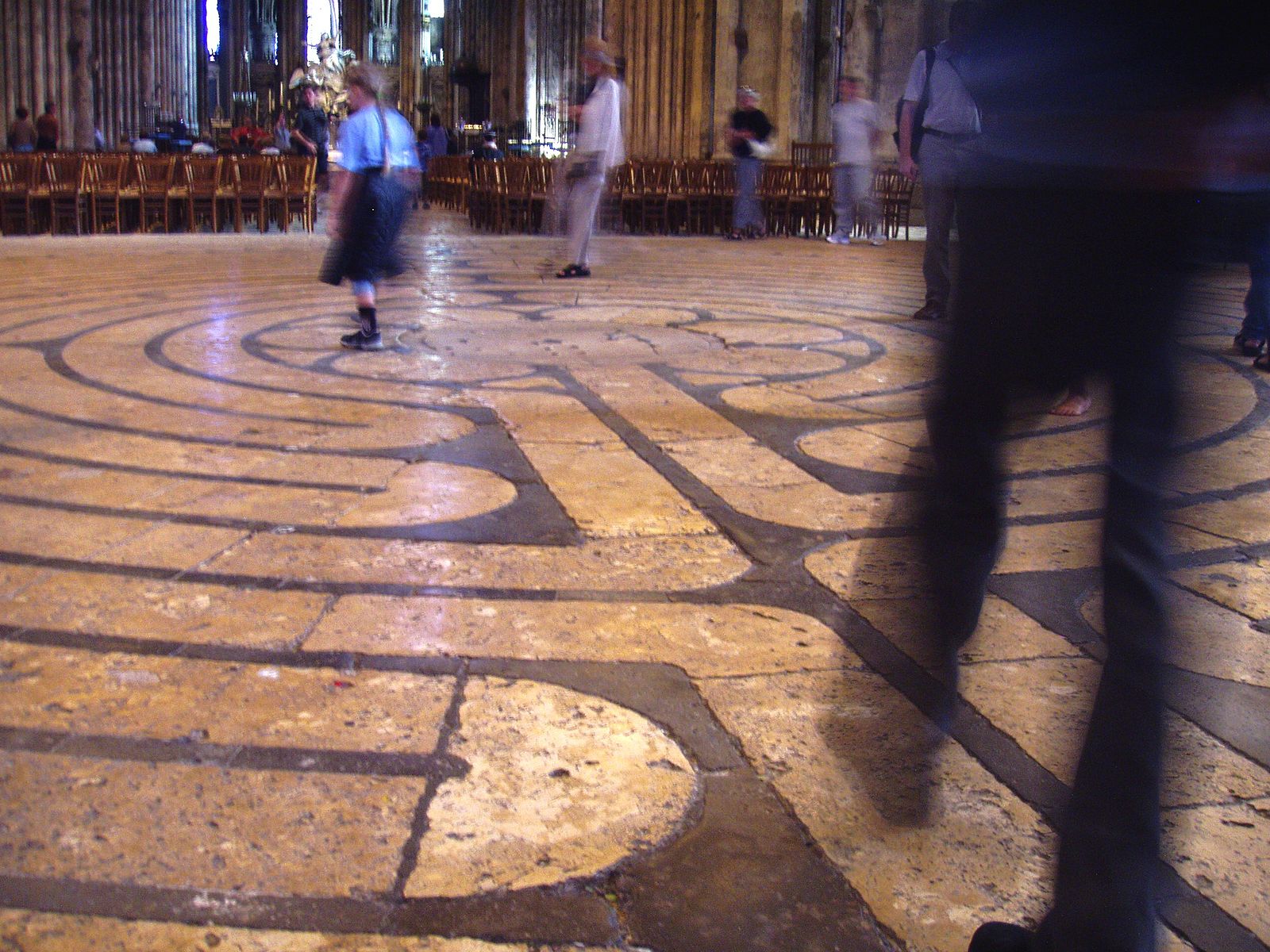
A photograph of visitors in motion walking on the labyrinth design of Chartres Cathedral.

Figure 15. The guidance of visitors is particularly visible in the distinctive labyrinth in the floor of the central nave of Chartres. January 13, 2006. Photograph. Wikimedia Commons. Maksm.

Medieval theories of the visual’s pedagogical-deliberative functions likewise treated them as moving through bodies, senses, and spaces on their way to shaping public life. Crossley, for example, demonstrates how the structures of Chartres Cathedral—its architectural design, sculpture, and windows—and the religious activity that took place within it were all coordinated as part of a larger rhetorical performance: a ductus that linked mind, body, space, and soul with clear intent at shaping behavior within the Cathedral and beyond. He describes, for example, how the ritual movement of the Bishop and his entourage during festival processions was designed to invoke and reanimate the biblical stories shown in the building’s sculpture and glass as well as the day’s specific themes. All those elements in concert were meant to make the practices and expectations of religious life palpable to the gathered community. They also reinscribed church hierarchies—placing the bishop in the role of Christ and as the proper leader of the town.33 The myriad visual elements of the cathedral and its ceremonies, in other words, had clear rhetorical purpose and were aimed not merely at viewers’ rational understanding but at their embodied participation in the community—both within and beyond the specific moment of religious worship.

Within this multi-sensory scene of pedagogical and deliberative rhetoric, stained glass was not simply an illustration for text-based teaching. The work of instructing the public and their souls was understood as inextricable from teaching the senses. Stained glass taught pilgrims and worshipers both about religious life and about how to engage in that life through sight. Through their arrangement in the space of the Cathedral and their own internal arrangement, the stained-glass windows communicated what Jordynn Jack has called a “pedagogy of sight.”34 They proposed to teach viewers through the scenes they depicted, and they aimed to teach viewers how to see as good Christians (for more about how sight itelf is rhetorical, check out chapter 5.

Such an education in the proper use of the senses was a high-stakes concern in Medieval religious education because sensory perception was understood as the first step toward thinking, doing, and being—for good or for ill.35 Without the proper instruction on how to perceive, the senses could lead away from the promise of eternal life. Vision in particular was seen as morally precarious—the eyes being closely linked with the soul and with the potential for “wandering eyes” that threaten to “infect” the viewer morally.36 Thus, sight was not only “guarded, but guided,” and stained glass played a role in illuminating the path laid before worshipers and pilgrims.37

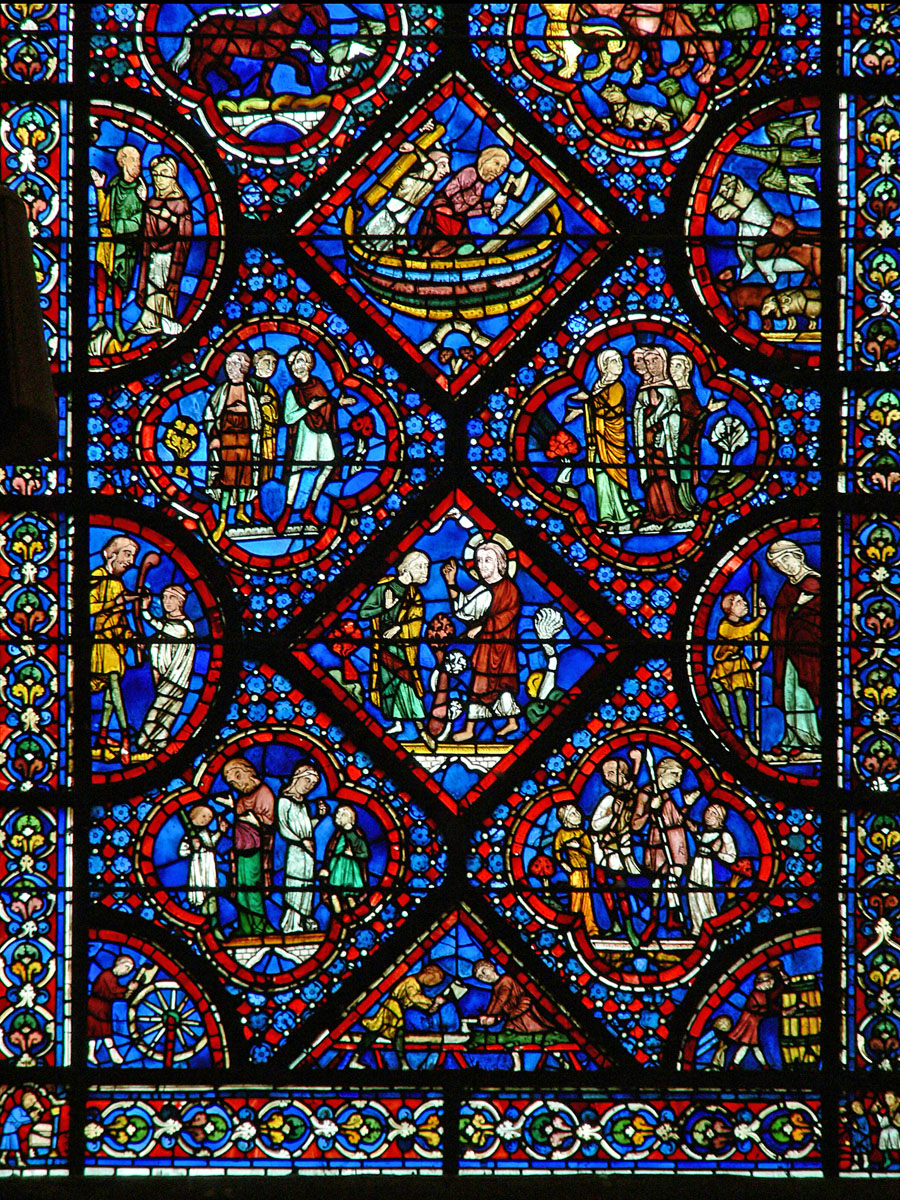
A photograph of the lower half of the Noah’s Arc window.

Figure 16. The Noah's Ark window. Photograph. Flickr. April 28, 2011. Walwyn.

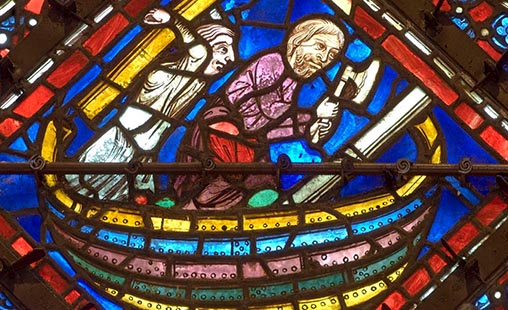
The Noah’s Arc window at Chartres usefully illustrates how those Medieval theories of sensorial risk and possibility were at work pedagogically and deliberatively in the Cathedral. There are forty separate scenes depicted within the Noah’s Arc window, and they follow an order that is instructive beyond conveying narrative structure. To “read” the main arc of the story, viewers follow the diamond-shaped panels at the center of the window upward, moving vertically as the story progresses through time from God telling Noah to build an arc, to the arrival of animals, the sending of a dove to look for land, and finally—at the apex—the rainbow that signified God’s promise to never flood the earth again. Viewers followed the story with their eyes, ultimately gazing up at the rainbow in emulation of Noah and his family.

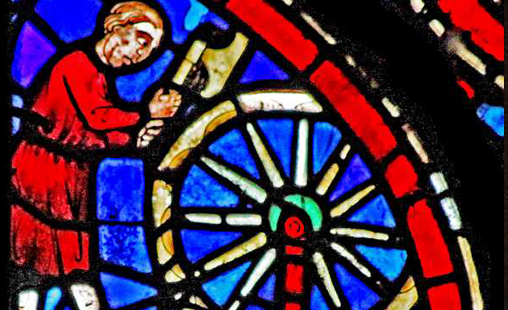
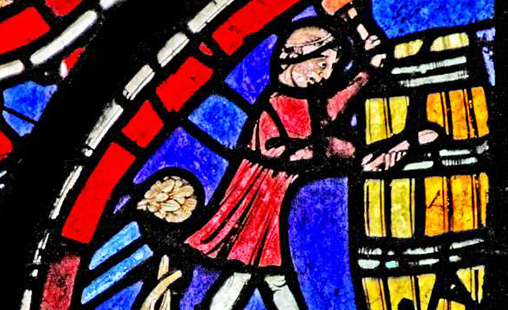
The scenes that surround that main story reaffirm the movement associated with it. As viewers moved their sight to increasingly higher planes, the pictures set in rosettes and semi-circles to the left and right of the central diamonds expand on the story of Noah and the flood and move from earthly to heavenly planes. Where the bottom-most frames—called the "signature panels"—show thirteenth-century tradespeople (the wheelwrights, carpenters, and coopers shown above) engaged in their ordinary work, the topmost frames are occupied by angels. Moving eyes and tilting heads toward the top of the window, pilgrims and worshippers were enacting their relationship to the divine and the proper attitude for prayerful engagement with the holy. Physically looking upward toward the divine was one way that both sermons and stained glass directed viewers away from immoral “naval-gazing.”38 As viewers gazed in the manner designed for them, they were also understood to be elevating their understanding. Bodily movement accompanied mental and spiritual movement.

Looking at Chartres' windows in this way—through the lens of the Medieval visual theories that infomed their creation—illuminates the pedagogical-deliberative purposes likely guiding the religious leaders who directed and designed the building of the Cathedral over a century. However, it tells us very little about how viewers in the thirteenth and subsequent centuries actually took up those lessons. It also risks obscuring other, less idealized ways that the pedagogical-deliberative functions of the visual were at work in the image-rich space of Chartres. To illuminate those elements, we need to turn to scholarship treating the power dynamics of the medieval period and to more recent rhetorical theories. Both offer skepticism about hegemonic institutional forms and thereby illuminate another aspect of the pedagogical-deliberative functions of the visual.

Depicting Docile Subjects


Recognizing how enmeshed both deliberation and rhetorical education are within dominant power structures, rhetorical scholars have taken two main critical routes to these topics in recent years: they have looked to counterhegemonic practices and rhetorical activities located outside of or against dominant publics, or they have turned their critical lenses on the institutions themselves, revealing the structures and systems that maintain dominant power and cultivate public acquiescence. Within visual rhetoric, much of the former work treats the visual’s catalytic and forensic functions, which we address in chapter 2. Here, we focus on the latter, as it frequently still treats pedagogical and deliberative functions, though with a healthy helping of skepticism about what, exactly, is being taught and whose futures are being served.

Two close-up photographs of panels in the Noah’s Arc window depicting tradesmen.

Figure 17. Section of the Noah's Ark window depicting a wheelwright trimming a wheel and a cooper tightening hoops on a barrel, Bay 47, Chartres Cathedral. Panels 1 and 3 of Bay 47. Photograph. Medievalart.co.uk. Accessed June 2019. Stuart Whatling.

In her landmark 2016 essay introducing racial rhetorical criticism, Lisa Flores highlights three “contemporary trajectories in racial rhetorical criticism,” including “Seeing Race.” Of that trajectory, Flores writes, “In their attention to dominant cultural, legal, and political texts, racial rhetorical scholars have centered the public figurations of race, noting how racially marked bodies are consistently made to do the cultural and political work of racism.”39 Karma Chávez’s “textual stare,” likewise, uses the mechanisms of sight to lay bare institutional habits—in Chávez’s case the habits of rhetorical studies itself—that otherwise go unmarked and unremarked.40

Such work can be applied to multiple rhetorical functions of the visual, but to the extent that it directs attention to the operations of governance or illuminates how institutional structures work, it is most closely aligned with the pedagogical-deliberative functions. Whether dealing with explicit legislative processes or more ambient politics, critical scholarship treating the visual as pedagogical and deliberative frequently analyzes these functions as constitutive—as making disciplined subjects who will participate in the public body in ways deemed appropriate.41

Turning back to Chartres, we can illuminate those subject-making aspects of the visual’s pedagogical-deliberative functions by looking past the windows themselves and into the conditions of their creation and the stories told about them in subsequent years.

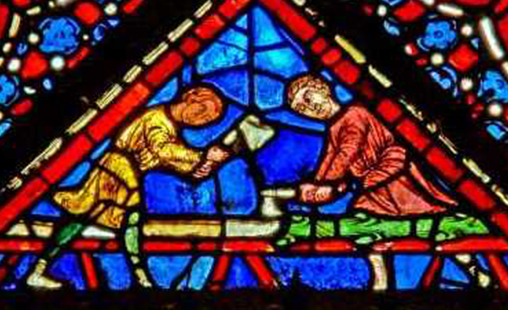
Many public-facing accounts of Chartres' stained-glass windows—from the centuries immediately following their installation through the present day—tell of harmony, cooperation, and miracles. In these rose-colored versions, typically generated by or on behalf of members of the Church hierarchy, the “signature panels” at the base of many windows were a direct illustration of life as it was in Chartres at the time of the Cathedral’s construction. These images, that commonly told story goes, were made to represent the various professional organizations who benefited from trade opportunities brought by the cathedral. The members of those professional organizations, in a show of support and devotion, were said to have donated funds for windows that honored their patron saints, which are depicted in higher registers above the scenes showing the (supposed) twelfth or thirteenth-century donors. In some of these accounts, such cooperation between the Cathedral’s leadership and the ordinary workers of Chartres is said to have been motivated in response to a fire that destroyed the partially built cathedral in 1194. In that story, the bishop, nobles, and tradesmen all worked together to rebuild the cathedral, honor the miracle of the survival of the cathedral’s main relic (the Virgin’s tunic), and boost the spirits of the townspeople.

Two close-up photographs of panels that both depict workers using axes in woodworking.

Figure 18. Carpenters stripping bark from a tree trunk and Noah and son building the ark, Bay 47, Chartres Cathedral. Panels 2 and 12 of Bay 47. Photograph. Medievalart.co.uk. Accessed June 2019. Stuart Whatling.

That story, however, tells us more about the complex of pedagogical-deliberative purposes at work in Chartres' stained glass than it does about the reality of the town—or relations between the Church and secular hierarchies more broadly—at the time. “Attractive as this picture might be,” writes Jane Williams, “it has little foundation in historical facts at Chartres.”42 This vision is, instead, “the product of many different assumptions by scholars,” including a tendency to rely on the windows themselves as evidence about social life at the time. Camille, likewise, notes, “It is the influence of a nineteenth-century nostalgic myth that leads one to think of these vast structures of stone, mortar and glass as expressing the social unity of the populace.”43 The endurance of that myth also points toward the rhetorical “sophistication of the cathedral clerics who devised these innovative windows to address specific audiences and to meet the contemporary challenge to their traditional authority posed by the transformations underway in late feudal society.”44 Their rhetorical efforts were, ultimately, so successful that they have shaped accounts of those windows—and the construction of the Cathedral—even to the present day.

Contemporary medievalists, not surprisingly, have a more skeptical take. And so, though the stories in which the windows are evidence of shared faith and shared mission continue to circulate as common sense, those stories—and windows—are better viewed as evidence of a constitutive project. That pedagogical-deliberative project aimed to manage different interests and negotiate ongoing antagonisms. It sought to establish as common a goal that was not, in fact, widely shared, and it worked to bring into being exactly the sort of religious subjects desired by church leaders.

The full spectrum of the pedagogical-deliberative work done by the “trade windows” cannot be fully understood without the context in which they were built. Taken on the surface, the appearance and organization of the trades imagery—especially in a location “previously reserved for the ruling class,”—might suggest a peaceful and cooperative process of building, one in which the ordinary folk of Chartres were enthusiastic participants in the Cathedral’s construction and treated as valuable participants in town life.45 Ecclesiastical documents tell a different story. As divisions of economic and jurisdictional power were being negotiated, uneasily, throughout the twelfth and thirteenth centuries, violence was more likely than cooperation between bishops, nobles, and townspeople. Nobles demanded oaths from bishops and other authorities with increasing frequency for fear that communal organization (by ecclesiastical or secular groups) would threaten their economic privileges. This included the count’s right to tax and control tradespeople through appointed officers and “masters” over town trades. This structure for trade taxation strongly suggests, Williams demonstrates, that trade organizations were unlikely to have donated windows for the Cathedral because they largely did not exist at the time. Indeed, trades were under the control of the local nobility. As Williams explains, “by mid-century, when the windows were presumably finished, only five trades besides the wool producers are known to have had some sort of organization: three had a master placed over them by the count, and one—the cloister butchers—had its organization outlawed by the chapter’s court.”46 These tense relationships between the trades, count, and church were sparked by increasing conflicts over the adoption of cloister serfs, who were exempted from the count’s taxes. The depth and scale of these conflicts is evidenced in the capture and murder of cathedral serfs by nobles, one instance of which led to a riot by townspeople. The tension and distrust was only magnified after this riot by the initiation of “yearly liturgical penance” to remind townspeople to not “repeat their transgression.”47

In this context, we can understand managing social conflict as an essential motivation for the windows. Conflict over power and competition for income between the town’s count, bishop, canons, and townspeople was the reality of Chartres in the thirteenth century. The windows imagine and propose a different future in line with the political-religious aims of the Church: one in which tradespeople and town leaders positioned themselves at the Church’s service and, through that service, moved toward salvation. The windows can therefore be seen as deliberative in the subject-making sense. Rather than praising existing conditions, they propose a vision for proper Christian polity going forward. Thus, the close relationship between church and town that appears in the windows through repeated imagery and close proximity can be understood not as a celebration of what is, but as a proposal for what ought to be and a modeling of “proper” relations set on religious leaders’ terms. Camille, in this vein, emphasizes that the cathedrals’ “advance architectural and technical complexity was symbolic not only of the wealth within but also of the power to exclude those without.”48 These sacred pictures in colored glass, like the more secular images often discussed by rhetoricians, aim to intervene in the formation of public opinion and carry arguments about public life and policy.49 Looking at the windows in this way, rhetoricians can recognize in them the pedagogical-deliberative functions of the visual as elements of governance, meant to both discipline behavior and set the frames in which public life could proceed—including influencing how the windows would eventually be interpreted as reflecting rather than obscuring the politics of their creation.

As with the common-sense story about the trade windows, there was a time when rhetorical studies’ frameworks for deliberation and rhetorical education imagined them as inherently neutral or—more commonly—beneficent functions. Those frameworks treated domination, control, and violence as external to—or perversions of—the civic projects of public deliberation and rhetorical education. Yet, as scholars in the past few decades have made abundantly clear, the pedagogical-deliberative functions of rhetoric not only carry the potential for violence, they are also—at least in some circumstances—constituted by violence.50 This reality, in tension with the lingering sense that deliberation and education are constitutively positive forces, means that rhetorical scholars must avoid over reliance on the visual’s pedagogical and deliberative functions when we engage public life. As the history of the Christian church in and beyond Europe reminds us, such functions can be used for deadly ends.
Deliberate Violence

While rhetorical education and deliberation can both be turned to counterpublic purposes, the strong tide of common sense about their beneficence means they easily serve normative purposes. The deliberative mode carries with it a problematic presumption, one not warranted by the reality of any polity that has ever existed: it assumes the presence of shared decision making. In the case of democratic deliberation, it further implies that the people engaged in decision-making processes are the ones most affected by them. Now, rhetoricians have long recognized that presumption as a fiction. We know that in Aristotle’s time the demos (people) of democracy was a highly restricted group. In Athens, citizenship belonged only to free men and only to those free men born within the borders of Athens. Democracies ever since have all been restricted in their own ways, and the notion that “the people” are able to come together to deliberate their future remains not just an unrealized ideal but a situation actively evaded by those holding power. Theories of the public sphere, likewise, have drawn attention to the crucial question of who gets to participate in the negotiation of public life, though they often maintain an optimism unwarranted by history (see, for example, Nancy Fraser’s concerns about the efficacy of public opinion within a transnational public sphere).51 In addition, we know that the decisions of one polity—even a fully and truly democratic one—inevitably affect human and non-human beings who are external to that polity (non-citizens, children, polar bears, etc. can't vote). None of these points erode the usefulness of rhetoric’s pedagogical-deliberative functions for producing or analyzing public discourse. They do, however, make it essential for rhetoricians to take note of when and how those functions can be most generatively engaged and when activating them might actually hide the full rhetorical complexity of a situation.

A photograph of the interior of Chartres Cathedral with warm yellow light cast from its windows.

Figure 19. Interior of Chartres Cathedral with a grand piano in the center. October 28, 2021. Photograph. Unsplash. Mick Haupt.

Although it is possible to emphasize pedagogical and deliberative functions while attending to inequity, violence, and the workings of power, the underlying presumptions of those functions tend to presume good intentions. Rhetoricians must, therefore, torque the frameworks of deliberation and rhetorical education and include caveats and counterpoints in order to insert critical awareness. The fact that such conscientious correction is necessary tells us that these functions, while useful, cannot be the only available means through which we understand how people negotiate public life and confront political decision-making.

To emphasize that point, we move from the stained glass and social conflict of Chartres to the more obviously fraught space of the Christian colonial enterprise—looking particularly to the rhetorical history of Spanish colonial conversion practices in the place the Spaniards named “New Spain.” We demonstrate the need for other frameworks and functions, beyond the pedagogical and deliberative, in order to name the violence of colonization.

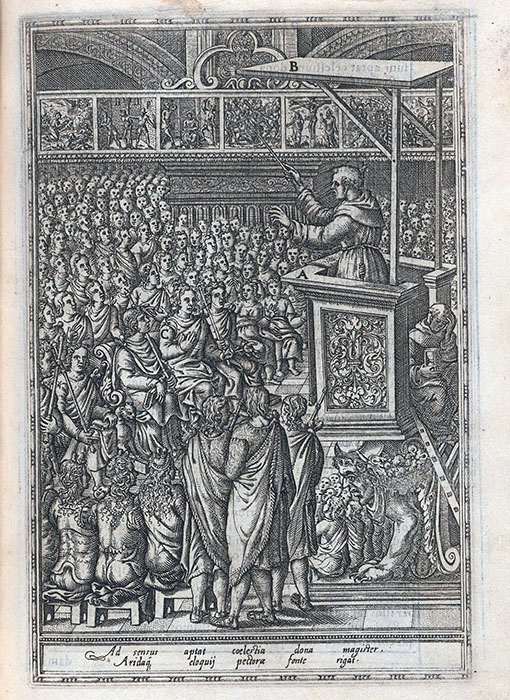
The earliest rhetoric textbook within the Spanish colonial context is Diego Valadés’s Rhetorica Christiana, published in 1579. Valadés, son of a Spanish father and a Tlaxcalan mother, received his initial education in the midst of colonial choque—at the first European schools founded in what had been Mexica territory. He was admitted to the Franscican order in the mid-1500s and continued his education at religious schools, coming to identify fully with his father’s heritage and the colonial project. “In his writing,” Abbott notes, “Valadés never identifies with the [Indigenous people he writes about]; they are always Indians, always the other.”52 Valadés’s textbook and subsequent rhetorics developed by the Spanish colonial project were tools of conversion. To the extent that they sought to understand Indigenous ways of being and knowing, it was always in service of more effectively wrenching Indigenous people away from those ways. These rhetorics helped subsequent missionaries joining colonial religious orders learn how to preach the gospel to the “heathen” masses of New Spain, and they presented the rhetorical work of conversion in pedagogical and deliberative fashion.

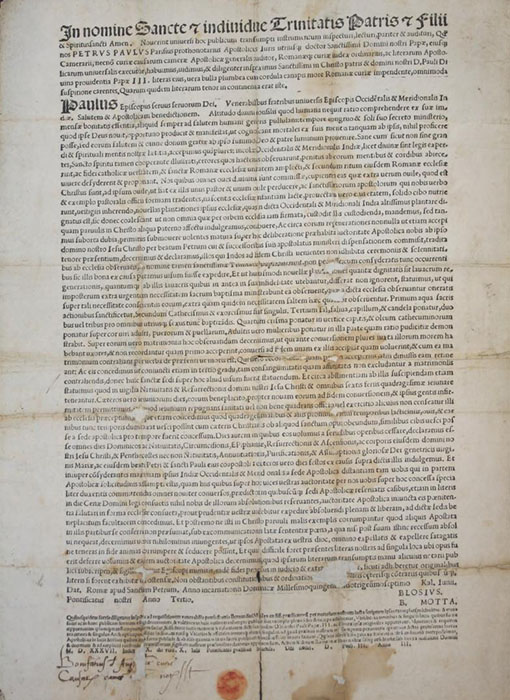
Photograph of a papal bull.
Photograph of a black and white sketch in a textbook.

Left: Figure 20. In Nomine Sancte.. Papal bull of Pope Paul III. 1537. Document Photograph. Library of Congress. Right: Figure 21. "Friar Preaching to Native Converts." In Diego Valadés. Rhetorica Christiana, 1579: 111. Textbook Illustration.

The 1537 Papal encyclical “Sublimis Deus, On the Enslavement and Evangelization of Indians,” Pope Paul III’s answer to the rampant murder and enslavement of Indigenous peoples throughout the so-called New World, conferred the privilege of humanity on those diverse peoples.53 Along with recognizing humanity came a prohibition against murder and enslavement and an obligation for conversion. “Sublimis Deus” is framed in pedagogical and deliberative terms. It extends colonizer obligation by invoking the Christian mandate to “Go ye and teach all nations,” asserting that Jesus gave that mission “without exception, for all are capable of receiving the doctrines of the faith.” It likewise extends a sense of polity to “the said Indians and all other people who may later be discovered by Christians,” such that they “may and should, freely and legitimately, enjoy their liberty and the possession of their property; nor should they be in any way enslaved.” Historians are clear that “Sublimis Deus” did little to protect the Indigenous peoples it so generously included in humanity. It did, however, pave the way for a generations-long conversion campaign, premised on the idea that conquest could legitimately take deliberative and pedagogical form.

Such pedagogical-deliberative conquest took form in rhetorics like the one published by Valadés. Informed by the principles of religious instruction available in Europe, Valadés’ Rhetorica Christiana took up and extended the blend of visual and verbal elements used to guide the faithful (or proto-faithful) to right belief. Lacking the infrastructure for stained glass, Valadés’ ideal preacher used painted screens to narrate Biblical stories and draw the Mexica, the Tlaxcalans, and their neighbors toward Christian polity. Later years brought elaborate festivals and parades that not only performed epideictic functions—see Chapter 3—but deliberative ones. They modeled an idealized polity of authority and acquiescence bound together through submission to the dictates of faith. As Diana Taylor and Max Harris have each demonstrated, Spanish colonial authorities never intended the Indigenous peoples of what became known as New Spain to take equal part in deliberations over the idealized colonial, Christian polity.54 The pedagogical-deliberative functions of the visual at work in these ongoing conversion and colonization efforts were created as means of obscuring or justifying violence. It is useful for rhetoricians to identify these uses of the pedagogical-deliberative function. However, limiting ourselves to it when our task is to understand public life in contexts that are not even nominally deliberative risks obscuring and justifying violence. The pedagogical-deliberative functions lend a veneer of reasonable politics to whatever we analyze with them.

Over-use of the pedagogical-deliberative function also risks missing, or misnaming, the means of engagement used by those resisting colonialism and colonial violence. The norms and expectations of the deliberative are less than useful for understanding how—through religious performance, syncretism, appropriation, and adaptation as well as physical resistance and uprising—the Mexica and other Indigenous groups of colonial New Spain engaged in picturing public futures against and despite Spanish colonization. Sidestepping deliberation and appropriating the means of rhetorical education, they modulated, refused, overwrote, and undercut the models of life together thrust upon them by colonizers who thought they held a monopoly on humanity, truth, and the means of persuasion.55

We hope that, at this point, readers have caught glimpses, both of what the pedagogical-deliberative functions of the visual can reveal and of why they cannot provide our only means for approaching the rhetorical functions of public life. Because the pedagogical-deliberative functions emerge out of contexts where decision-making and political options are public projects, they prioritize spaces of power and the people holding that power. We can, in a pedagogical-deliberative mode, critique the visions developed by Valadés and the political and religious authorities of colonial New Spain, but we also must acquiesce to having those authorities at the center of public life in order to enact that critique. Especially in a context like that of New Spain, where the colonial archive is generally presumed to have obliterated or mediated all possibility of direct knowledge about pre-Columbian Indigenous life, choosing a pedagogical-deliberative lens focuses visual rhetoricians’ attention on pictures produced by and for the powerful, even when we also carry critical, anti-colonial purposes. In New Spain and many other colonial contexts, rhetorical education and deliberation belong to the colonial enterprise. Emphasizing their rhetorical functions therefore risks obscuring the violence of that enterprise and missing multiple means of engaging otherwise. Seeing such rhetorics otherwise will ultimately require highlighting other rhetorical functions of the visual.


Chapter 1 Notes

  1. Jeffrey Walker, The Genuine Teachers of this Art: Rhetorical Education in Antiquity. (Columbia: University of South Carolina Press, 2011), 3.

  2. Walker, The Genuine, 1.

  3. Jens E. Kjeldsen, “Visual Rhetoric and the Power of Imagery: A Brief Lesson in the Rhetorical Power of Images and the Need for phronesis and krisis in the Teaching of Visual Rhetoric,” Video Journal of Education and Pedagogy 6 (23 Dec 2021): 2.

  4. Arabella Lyon, Deliberative Acts: Democracy, Rhetoric, and Rights. (University Park, PA: Penn State University Press, 2015).

  5. Jessica Enoch, Refiguring Rhetorical Education: Women Teaching African American, Native American, and Chicano/a Students, 1865-1911 (Carbondale: Southern Illinois University, 2008).

  6. Isocrates, “Antidosis," in The Rhetorical Tradition: Readings from Classical Times to the Present, 2nd ed., ed. Patricia Bizzell and Bruce Herzberg (Bedfort/St. Martin’s Press, 2001), 50-54.

  7. Sonya Barrera Eddy, “Rechazo Rhetoric: Chicanx and Latinx Resistive Strategies that Ignite Deliberation,” (PhD Diss., University of Texas at San Antonio, 2019); Kjeldsen, “Visual.”; Lynda Walsh, "The Visual Rhetoric of Climate Change," WIREs Climate Change 6 (July/August 2015): 361-68.

  8. Stanley Norris Olson, “Confidence Expressions in Paul: Epistolary Conventions and the Purpose of 2 Corinthians,” (PhD Diss., Yale University, 1976); Stanley E. Porter and Thomas H. Olbricht, eds. Rhetoric and the New Testament: Essays from the 1992 Heidelberg Conference, JSNT Supplement Series 90. (London: Sheffield Academic Press, 1993); Stanley E. Porter and Bryan R. Dyer, eds., Paul and Ancient Rhetoric: Theory and Practice in the Hellenistic Context. (Cambridge: Cambridge University Press, 2016).

  9. Martin Camper, "The Future of the History of Rhetoric is Religious," Journal for the History of Rhetoric 23, no. 1 (2020): 104-105; Andre E. Johnson, The Forgotten Prophet: Bishop Henry McNeal Turner and the African American Prophetic Tradition. (Lanham, ME: Lexington Books, 2012); Roxanne Mountford, The Gendered Pulpit: Preaching in American Protestant Spaces. (Carbondale: Southern Illinois University Press, 2003).

  10. David Holmes, Where the Sacred and the Secular Harmonize: Birmingham Mass Meeting Rhetoric and the Prophetic Legacy of the Civil Rights Movement (Eugene, OR: Cascade Press, 2017); David Holmes, "Black Religion Mattes: African American Prophecy as a Theoretical Frame for Rhetorical Interpretation, Invention, and Critique" in Ryan Skinnel et al., eds. Reinventing (with) Theory in Rhetoric and Writing Studies: Essays in Honor of Sharon Crowley. (Logan: Utah State University Press, 2019), 243-255; Andre E. Johnson and Anthony J. Stone, "'The Most Dangerous Negro in America': Rhetoric, Race and the Prophetic Pessimism of Martin Luther King Jr.," Journal of Communication and Religion 41, no. 1 (2018): 8-22.

  11. Paul Crossley, “Ductus and Memoria: Chartres Cathedral and the Workings of Rhetoric,” In Rhetoric Beyond Words: Delight and Persuasion in the Arts of the Middle Ages, ed. Mary Carruthers, (Cambridge: Cambridge University Press, 2010), 242.

  12. Nan Johnson, Gender and Rhetorical Space in American Life, 1866-1910, (Carbondale: Southern Illinois University Press, 2002), 1. See also, Allison Dziuba, "Countercurricular Rhetorical Education: Reimagining the University from the Inside Out," Communication and Critical/Cultural Studies 20, no. 2 (2023): 174-181; Michael J. Steudeman, "Rethinking Rhetorical Education in Times of Demagoguery,” In Rhetoric’s Demagogue | Demagoguery’s Rhetoric [Special Issue], ed. Ryan Skinnell and Jillian Murphy, Rhetoric Society Quarterly 49, no. 3 (2019): 297-314; Amy J. Wan, Producing Good Citizens: Literacy Training in Anxious Times. (Pittsburgh, PA: University of Pittsburgh Press, 2014).

  13. See, for example, Enoch, Refiguring Rhetorical Education; Louis M. Maraj, Black or Right: Anti/Racist Campus Rhetorics (Utah State University Press, 2020); Stephen A. Schneider, You Can't Padlock an Idea: Rhetorical Education at the Highlander Folk School, 1932-1961 (Columbia: University of South Carolina Press, 2014); Elaine B. Richardson, "Centering Black Mothers' Stories for Critical Literacies," English Teaching: Practice & Critique 19, no. 1 (2020): 21-33; Pamela VanHaitsma, Queering Romantic Engagement in the Postal Age: A Rhetorical Education. (Columbia: University of South Carolina, 2019).

  14. Michael Camille, Image on the Edge: The Margins of Medieval Art (London: Reaktion Books, 1992), 77.

  15. See Kjeldsen, “Visual,” 4-7 for a brief, clear debunking of this well established myth about the power of pictures. For an example of the myth in action, see Christa J. Olson and Nancy Reddy, "'The Advantages of Knowing How to Read and Write:' Literacy, Filmic Pedagogies, and the Hemispheric Projection of US Influence," Literacy in Composition Studies 3, no. 3 (October 2015): 110-130.

  16. See, for example, the discussion of Gordon Parks' 1956 photograph "Department Store, Mobile, Alabama" in "The 25 Photos That Defined the Modern Age" New York Times Style Magazine, June 3, 2024.

  17. Cara A. Finnegan and Jiyeon Kang, “‘Sighting’ the Public: Iconoclasm and Public Sphere Theory,” Quarterly Journal of Speech 90, no. 4 (November 2004): 377–402.

  18. Caitlin F. Bruce and Cara A. Finnegan, "Visual Rhetoric in Flux: A Converstion," Rhetoric & Public Affairs 24, no. 1-2 (2001): 103; Kjeldsen, “Visual”; Cara A. Finnegan, "The Naturalistic Enthymeme and Visual Argument: Photographic Representation in the 'Skull Controversy,'" Argumentation and Advocacy 37 (Winter 2001): 133-49.

  19. Cara A. Finnegan, "Recognizing Lincoln: Image Vernaculars in Nineteenth-Century Visual Culture," Rhetoric & Public Affairs 8, no. 1 (2005): 31-58; E. Johanna Hartelius, "'Leave a Message of Hope or Tribute': Digital Memorializing as Public Deliberation," Argumentation and Advocacy 47, no. 2 (2010): 67-85; Mari Barr Tonn, “Militant Motherhood: Labor’s Mary Harris “Mother” Jones,” Quarterly Journal of Speech 82, no. 1 (1996): 1-21.

  20. See, for example, J. Anthony Blair, "The Possibility and Actuality of Visual Arguments," Argumentation and Advocacy 33, no. 1 (Summer 1996): 23-39; David Fleming, “Can Pictures Be Arguments?” Argumentation and Advocacy 33, no. 1 (Summer 1996): 11–23; Kjeldsen, “Visual”; Walsh, “The Visual”; David S. Birdsell and Leo Groarke, eds., “Toward a Theory of Visual Argument [Special Issue],” Argumentation and Advocacy 33, no. 1–2 (1996): 1–39, 56–80; Trevor Parry-Giles, "Resisting a 'Treacherous Piety': Issues, Images, and Public Policy Deliberation in Presidential Campaigns," Rhetoric & Public Affairs 13, no. 1 (2010): 37-64; Christa Teston, "Moving from Artifact to Action: A Grounded Investigation of Visual Displays of Evidence during Medical Deliberations," Technical Communication Quarterly 21 (2012): 187-209.

  21. See, for example, Kevin Michael DeLuca and Jennifer Peeples, “From Public Sphere to Public Screen: Democracy, Activism, and the ‘Violence’ of Seattle,” Critical Studies in Media Communication 19, no. 2 (June 2002): 125–51; Hartelius, “Digital Memorializing.”

  22. Carruthers, Mary. “The Concept of Ductus, or, Journeying through a Work of Art.” In Rhetoric Beyond Words: Delight and Persuasion in the Arts of the Middle Ages. Mary Carruthers, ed. Cambridge: Cambridge University Press, 2010: 201.

  23. Crossley, “Ductus,” 215-216.

  24. Crossley, “Ductus,” 230.

  25. Carruthers, “Concept of Ductus,” 190.

  26. Carruthers, “Concept of Ductus," 200.

  27. Virginia Chieffo Ragiun, Stained Glass: Radiant Art (Los Angeles: Getty Publications, 2013), 67, 77-79.

  28. Raguin, Stained Glass, 120-1; Crossley, "Ductus"; Claudine Lautier, "The Sacred Topography of Chartres Cathedral: The Reliquary Chasse of the Virgin in the Liturgical Choir and Stained-Glass Decoration," in Evelyn Staudinger Lane, ed. The Four Modes of Seeing: Approaches to Medieval Imagery in Honor of Madeline Harrison Caviness. (New York: Routledge, 2009): 174-196.

  29. See, for example, Robert s. Cathcart, "Movements: Confrontation as Rhetorical Form," in Charles E. Morris III and Stephen Howard Browne, eds. Readings on the Rhetoric of Social Protest (State College, PA: Strata Publishing, 2006), 95-103; Edward P.J. Corbett, "The Rhetoric of the Open Hand and the Rhetoric of the Closed Fist," College Composition and Communication 20, no. 5 (1969): 288-96; Richard B. Gregg, "The Ego-Function of the Rhetoric of Protest," Philosophy & Rhetoric 4, no. 1 (1971): 71-91; Franklyn S. Haiman, "The Rhetoric of the Streets: Some Legal and Ethical Considerations," Quarterly Journal of Speech 53 (1967): 99-114; Robert L. Scott and Donald K. Smith, "The Rhetoric of Confrontation," Quarterly Journal of Speech 55 (1969): 1-8.

  30. This transition moves from the "body rhetorics" of the 1990s to the "visceral publics" of the 2020s, helped along by scholarship beyond rhetoric demonstrating that old common-sense distinctions between mind and body and rationality and feeling were, essentially, bunk. See, e.g. Stephanie R. Larson, "'Everything Inside Me Was Silenced': (Re)defining Rape through Visceral Counterpublicity," Quarterly Journal of Speech 104, no. 2 (2018): 123-44; Jenell Johnson, "'A Man's Mouth is His Castle': The Midcentury Flouridation Controversy and the Visceral Public," Quarterly Journal of Speech 102, no. 1 (2016): 1-20; Jack Selzer and Sharon Crowley, eds., Rhetorical Bodies. (Madison: University of Wisconsin Press, 1999).

  31. See, for example, Jennifer Lin LeMesurier, "Winking at Excess: Racist Kinesiologies in Childish Gambino's 'This Is America.'" Rhetoric Society Quarterly 50, no. 2 (2020): 139-51.; Christa J. Olson, "Casta Painting and the Rhetorical Body," Rhetoric Society Quarterly 39, no. 4 (2009): 307-30.

  32. See, for example, Caitlin F. Bruce, Voices in Aerosol: Institutional Attunement, Youth Culture, and Graffiti in Urban Mexico (Austin: University of Texas Press (2024); Leigh Elion, "Visualizing Changing Communities: Gentrification and the Rhetoric of Public Art in 21st-Century San Francisco" (PhD Diss., University of Wisconsin-Madison, 2017); Cara A. Finnegan, Making Photography Matter: A Viewer's History from the Civil War to the Great Depression. (Champaign: University of Illinois Press, 2017); Laurie E. Gries, Still Life with Rhetoric: A New Materialist Approach for Visual Rhetorics. (Logan: Utah State University Press, 2015).

  33. Crossley, “Ductus,” 229.

  34. Jordynn Jack, “A Pedagogy of Sight: Microscopic Vision in Robert Hooke’s Micrographia,” Quarterly Journal of Speech 95, no. 2 (May 2009): 192–209.

  35. Richard G. Newhauser, “Morals, Science, and the Edification of the Senses,” in Optics, Ethics, and Art in the Thirteenth and Fourteenth Centuries: Looking into Peter of Limoges’s ‘Moral Treatise on the Eye,’” ed. Richard L. Kessler and Richard G. Newhauser. (Toronto: Pontifical Institute of Medieval Studies, 2018): 17-28.

  36. Newhauser, “Morals,” 8.

  37. Newhauser, “Morals,” 9.

  38. Carolyn Muessig, “‘Can’t take my eyes off you’: Mutual Gazing Between the Divine and Humanities in Late Medieval Preaching,” in Optics, Ethics, and Art in the Thirteenth and Fourteenth Centuries: Looking into Peter of Limoges’s ‘Moral Treatise on the Eye,’” ed. Richard L. Kessler and Richard G. Newhauser. (Toronto: Pontifical Institute of Medieval Studies, 2018), 20.

  39. Lisa A. Flores, “Between Abundance and Marginalization: The Imperative of Racial Rhetorical Criticism,” Review of Communication 16, no. 1 (January 2, 2016): 13.

  40. Karma R. Chávez, "The Body: An Abstract and Actual Rhetorical Concept," Rhetoric Society Quarterly 48, no. 3 (2018): 242-50.

  41. See for example, Robert Asen. “Imagining the Public Sphere," Philosophy & Rhetoric 35, no. 4 (2002): 345-67; Christina Cedillo, "Unruly Borders, Bodies, and Blood: Mexican 'Mongrels' and the Eugenics of Empire," Journal for the History of Rhetoric 24, no. 1 (2021): 7-23; Christa J. Olson, American Magnitude: Hemispheric Vision and Public Feeling in the United States (Columbus: Ohio State University Press, 2021).

  42. Williams, Bread, 3.

  43. Camille, Image, 77.

  44. Williams, Bread, 2.

  45. Williams, Bread, 1.

  46. Williams, Bread, 11.

  47. Williams, Bread, 27.

  48. Camille, Image, 77.

  49. Asen, “Imagining”; Gretchen S. Barbatsis, “‘Look, and I Will Show You Something You Will Want to See’: Pictorial Engagement in Negative Political Campaign Commercials,” Argumentation and Advocacy 33 (Fall 1996): 69–80; Cara A. Finnegan, Picturing Poverty: Print Culture and FSA Photographs (Washington, DC: Smithsonian Institution Press, 2003); Trevor Parry-Giles, “Resisting a ‘Treacherous Piety’: Issues, Images, and Public Policy Deliberation in Presidential Campaigns,” Rhetoric & Public Affairs 13, no. 1 (2010): 37–64.

  50. Ersula J. Ore, Lynching: Violence, Rhetoric, and American Identity (Jackson: University Press of Mississippi, 2019).

  51. Fraser, “Rethinking”; Fraser, “Transnationalizing,” 17.

  52. Don Paul Abbott, Rhetoric in the New World: Rhetorical Theory and Practice in Colonial Spanish America (Columbia: University of South Carolina Press, 1996), 45.

  53. Pope Paul III. “Sublimis Deus: On the Enslavement and Evangelization of Indians,” 1537, Papal Encyclopedia Online, accessed July 18, 2024.

  54. Max Harris, Aztecs, Moors, and Christians: Festivals of Reconquest in Mexico and Spain, 1st ed. (Austin: University of Texas Press, 2000); Diana Taylor, The Archive and the Repertoire: Performing Cultural Memory in the Americas, (Durham, NC: Duke University Press, 2003).

  55. Rolena Adorno, Guaman Poma: Writing and Resistance in Colonial Peru, (Austin: University of Texas Press, 2000); Damián Baca and Victor Villanueva, eds. Rhetorics of the Americas: 3114 BCE to 2012 CE (New York: Palgrave Macmillan, 2010); Christa J. Olson and Rubén Casas, “Felipe Guaman Poma de Ayala’s Primer Nueva Corónica y Buen Gobierno and the Practice of Rhetorical Theory in Colonial Peru,” Quarterly Journal of Speech 101, no. 3 (July 3, 2015): 459–84; Susan Romano, "Tlaltelolco: The Grammatical-Rhetorical Indios of Colonial Mexico," College English 66, no. 3 (January 2004): 257-77.