Chapter Two

Catalytic Vision

“Still photographs are the most powerful weapons in the world.” —Eddie Adams
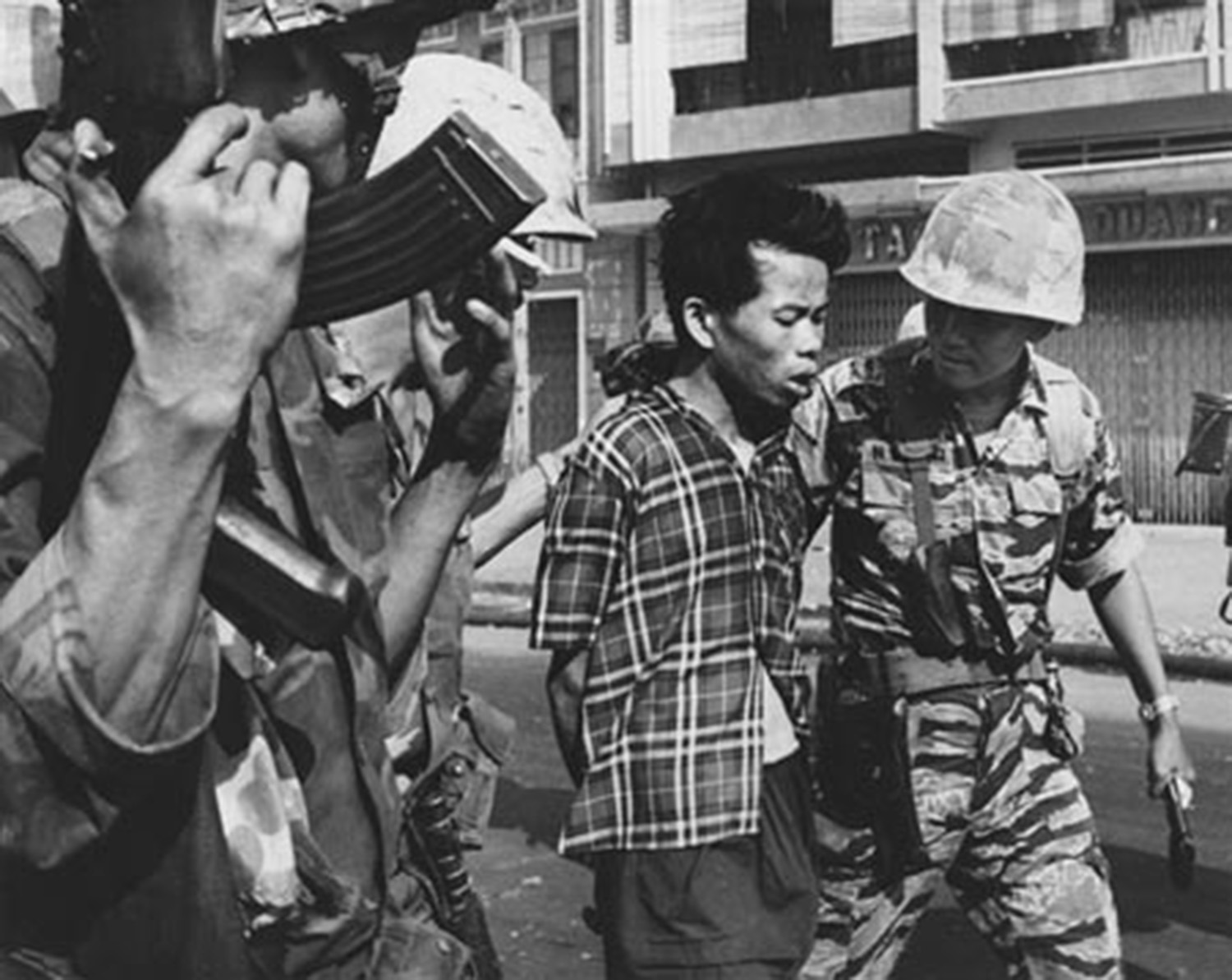
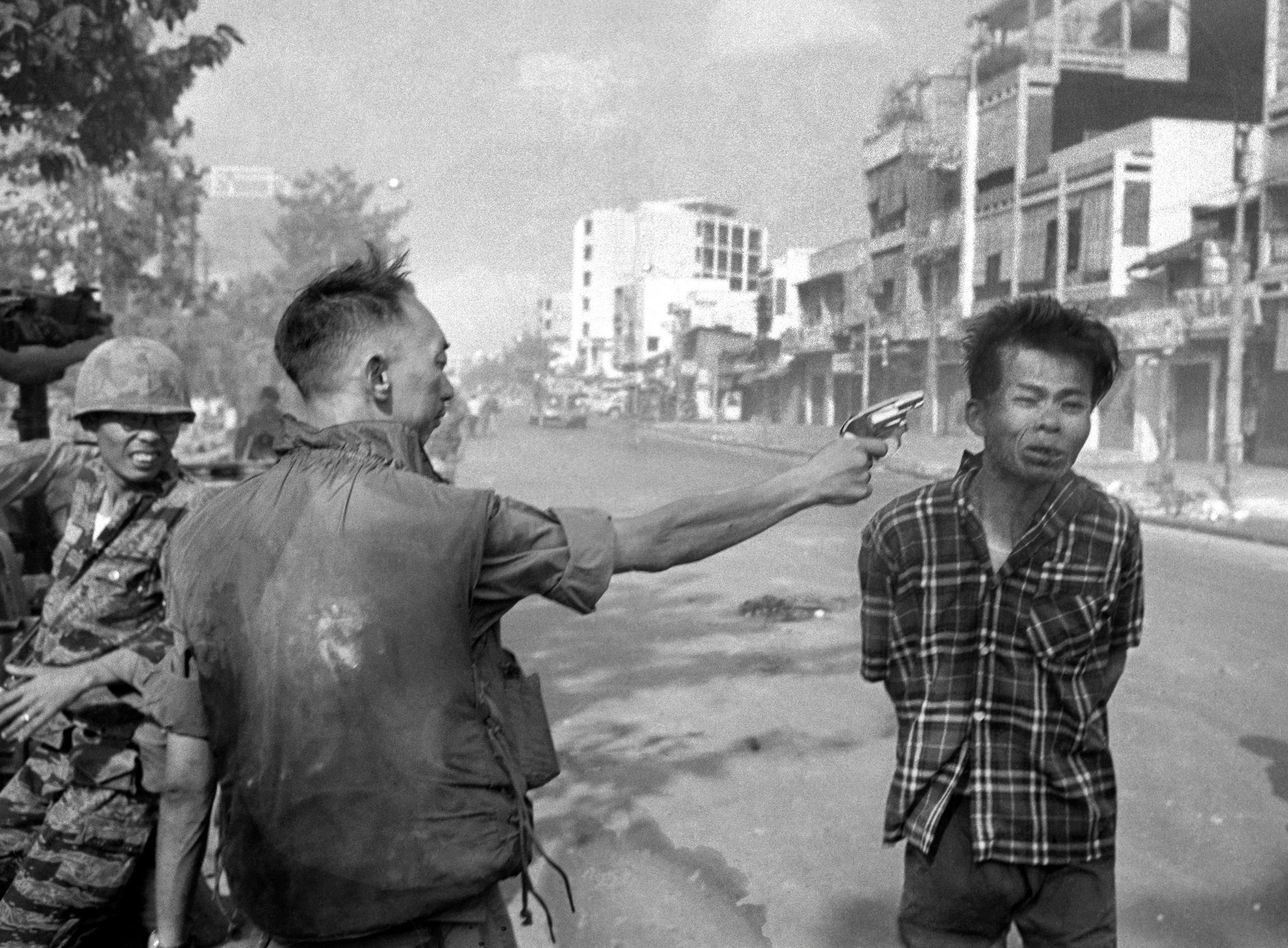
Black and white photograph of a captured Viet Cong officer, Nguyen Van Lem, led by South Vietnamese soldiers, moments before being executed.

Figure 6. Moments before Saigon Execution, February 1, 1968. Photograph. Associated Press. Eddie Adams.

On February 1, 1968, during the Tet Offensive, Associated Press photographer Eddie Adams set out to photograph a street battle happening in Saigon. He found more than he expected. The next day, his pictures showing Brigadier General Nguyen Ngoc Loan’s summary execution of a Viet Cong officer appeared on front pages and major TV news networks across the United States. Adams’s photograph taken at the moment of the execution became one of the Vietnam War’s most iconic images. It has been credited with significant influence, both on the course of the War and on Adams’s and Loan’s lives.

The idea that photographs like Adams’ hold power over us is commonplace. Pictures grab us, change us, and push us.

Or, at least, we imagine they do.

That popular sense of pictures’ efficacy echoes across rhetorical scholarship.

Rhetorical scholars have long sought evidence of rhetorical force and effect, driven by our disciplinary investment in persuasion. For this reason, pictures that have achieved documentable persuasion have garnered a great deal of attention from rhetorical scholars, and powerful pictures more broadly have dominated visual rhetoric scholarship. Rhetoricians have long assumed that what makes vision rhetorical is its ability to move audiences to action, and we have therefore sought out pictures that exemplify that assumption.
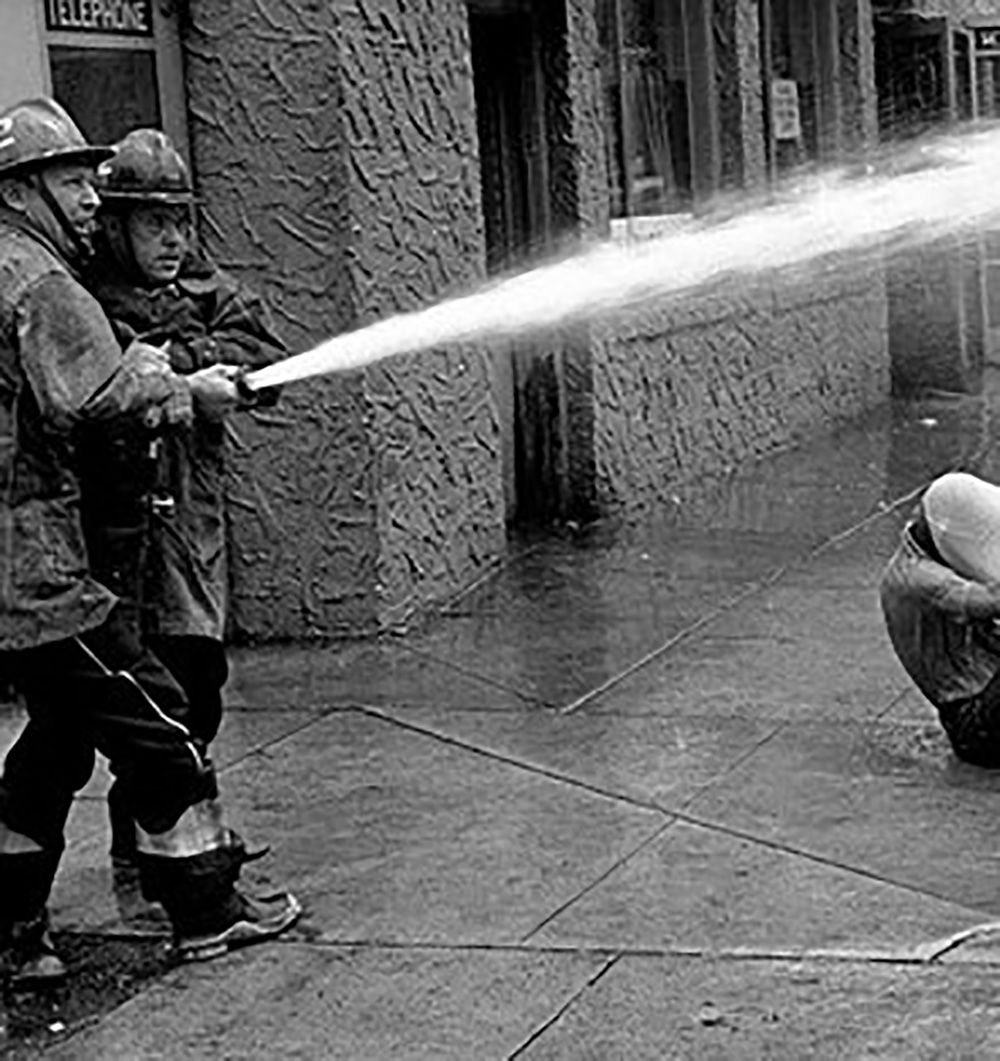
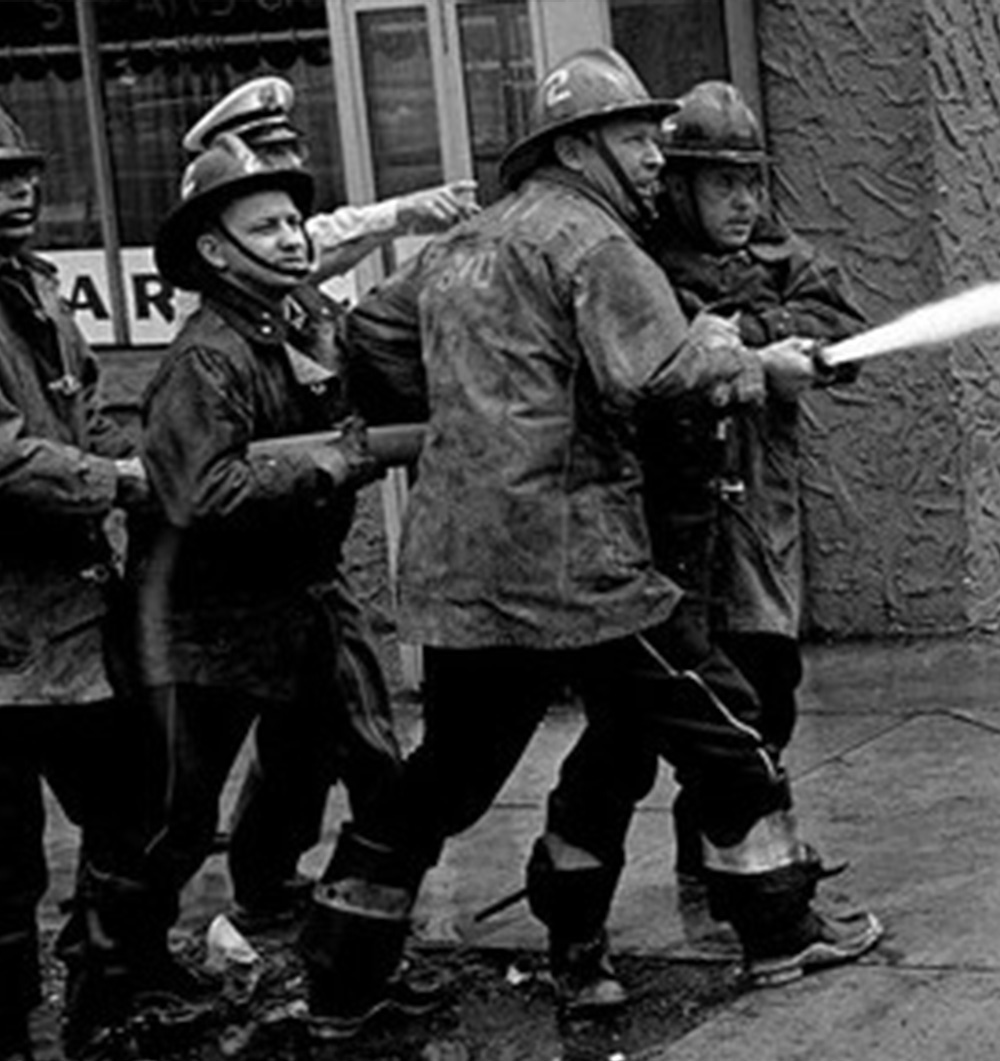
Figure 22. Group of African Americans, marching near the Capitol building in Washington, DC, to protest the lynching of four African Americans in Georgia. 1964. Photograph. Library of Congress. https://www.loc.gov/item/97519566/

The catalytic—in other words—is the most frequently invoked and sought after rhetorical function of the visual. That focus on the visual as a means of impelling action has meant that visual rhetoric scholarship has often turned to the visual culture of social movements and public protest. As we note in the previous chapter, the first twentieth-century rhetoricians to directly address visual force were white scholars grappling with the social movements of the 1960s and 1970s, particularly youth-led protests and the civil disobedience strategies of the Civil Rights and Black Power movements. They wanted to understand the bodies, pictures, and actions that were (to their minds) eclipsing verbal argument and shaking the familiar, ‘logical’ foundations of their field.1 These early engagements with the visual struggled to make a place for the (non-rational) visual in light of its undeniable power to indict and move. Over time, this scholarship shifted how rhetoricians think about the visual’s deliberative functions. More immediately, it highlighted catalytic functions—how and why visual perception moved people into action.

Subsequent visual rhetoric scholarship emphasizing the catalytic functions of the visual has focused on the question of judgment, on the sort of responses that pictures prompt, and on their relation to other modes of persuasion. In this vein, attending to the visual allows a more robust understanding of how judgment happened in a particular situation. Without looking at pictures, these scholars assert, we can’t see the full story of how change happened. Davi Johnson’s “MLK Jr’s 1963 Birmingham Campaign as Image Event” is emblematic of this tendency. She argues that we cannot see what happened in Birmingham or the full extent of Dr. King’s argument about white moderates in the “Letter from Birmingham Jail” without looking critically at photographs.2 Scholarship treating this rhetorical function of the visual generally presumes that we cannot understand the judgment rendered or the actions taken if we do not attend to the catalytic force of pictures.
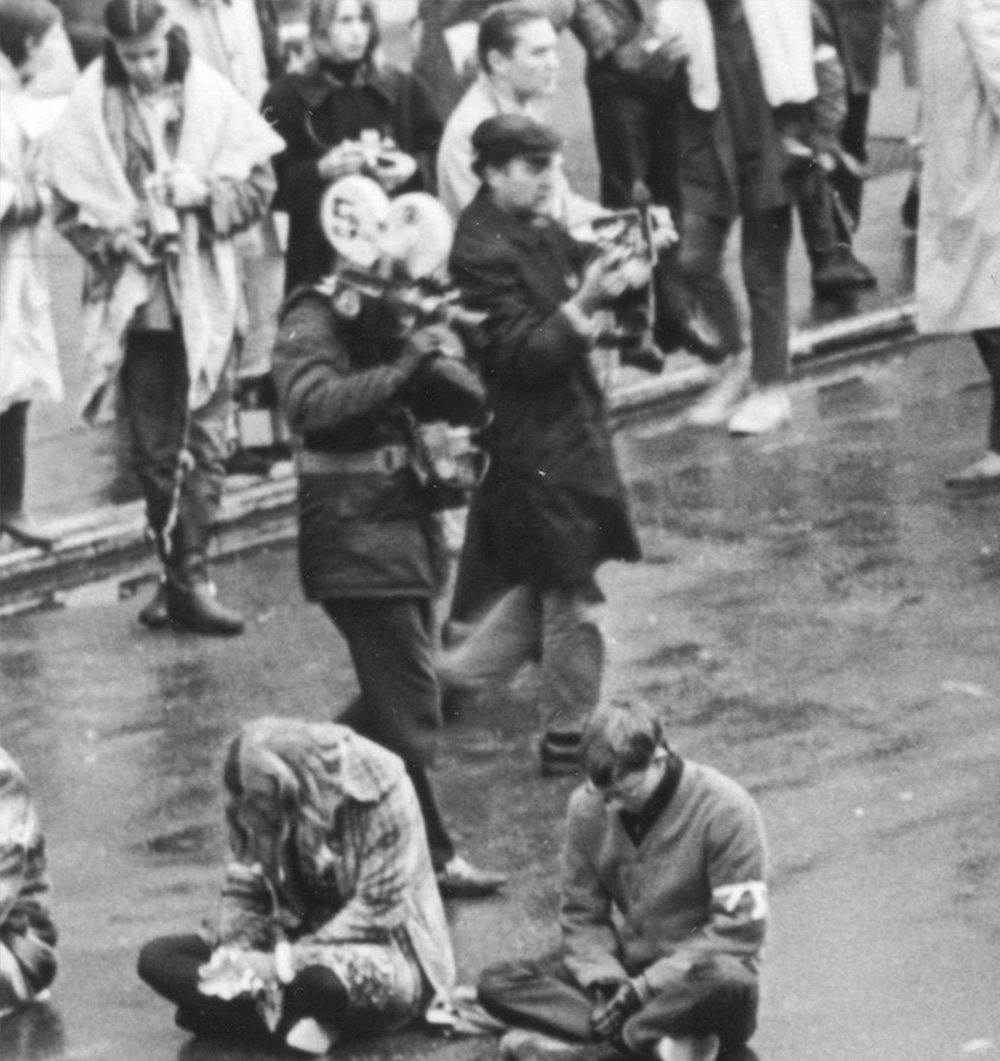
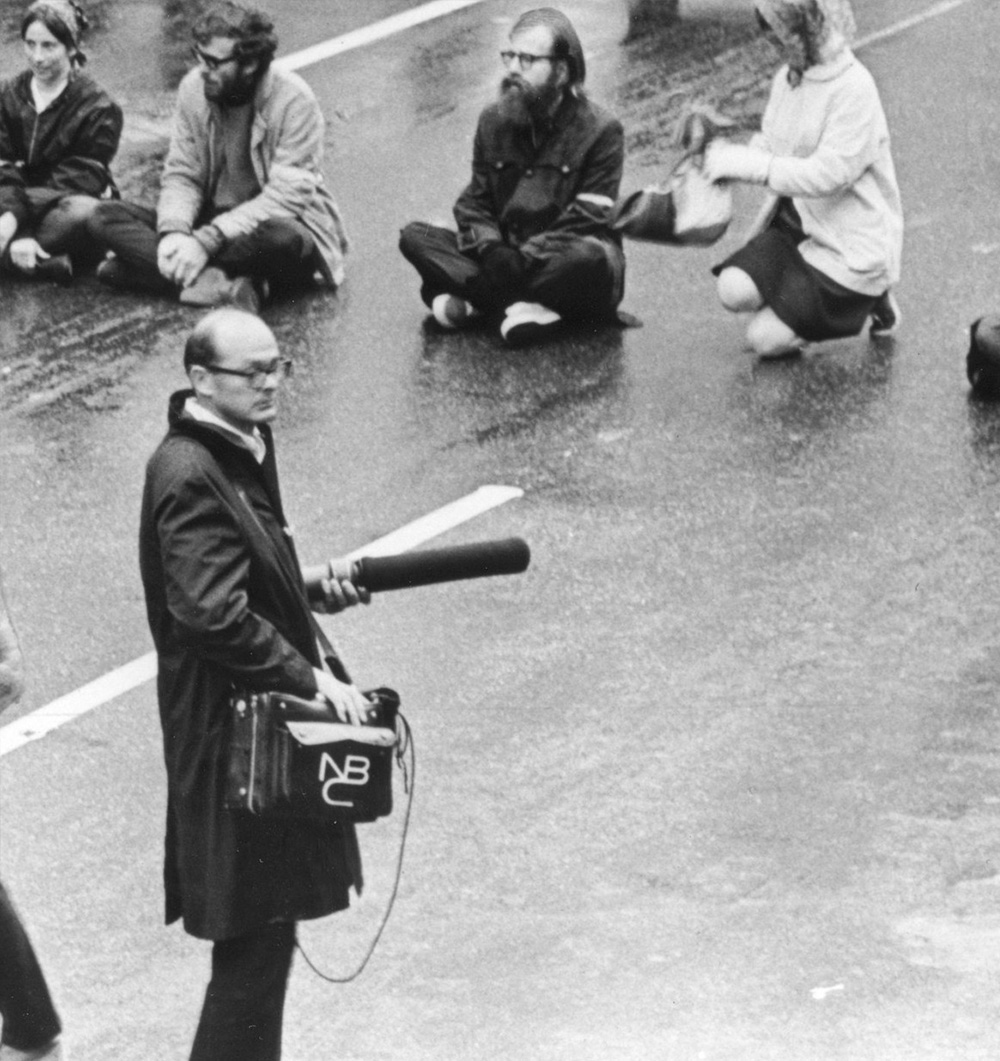
Figure 23. Anti-war demonstration in Oakland, California. H95.18.908 photograph. December 18, 1967. The Oakland Tribune Collection, the Oakland Museum of California. Gift of ANG Newspapers. ©The Oakland Museum of California.

Despite a healthy skepticism about the power of rhetoric, visual rhetoric scholars continue to be fascinated by moments when pictures do seem to initiate action—especially in contexts where words have been insufficient. In one of the earliest contemporary studies centering visual objects, Robert L. Scott analyzed Diego Rivera’s Rockefeller Center fresco as a cause and consequence of argument, and he noted that Rivera’s art catalyzed action—its own destruction not least.3 Christine Harold and Kevin DeLuca trace how Emmett Till’s open casket and the sight of his mutilated, murdered body energized African American communities in the long battle against white supremacy.4 Johnson demonstrates that Charles Moore’s photographs from Birmingham in 1963 fundamentally changed white perspectives on the U.S. Civil Rights Movement.5 And Christa noted in 2018 how pictures of children separated from their parents at the U.S. border briefly sparked public outrage about then President Trump’s immigration policy.6 In this focus on the catalytic, pictures are a means by which viewers assess what has happened and are invited to sit as judges over an issue or "case" before them. Some of the first discussions of visual power as explicitly rhetorical—in Quintilian—are literally forensic: they come from famous trials. And visual rhetoric scholarship has returned repeatedly to such moments of judgment. When pictures lead to public verdicts, it is hard to deny them a place in the rhetorical pantheon.
In this chapter

Eddie Adams’ photograph serves as an ideal representative anecdote for that catalytic function of the visual, and it points as well to the resonances between the catalytic function and the “forensic” branch of rhetoric. Adams’s picture—like many catalytic images—indicts and convicts in the process of activating. Working through that photograph and its contexts, we highlight the contours of this seductive, evocative, exceptional rhetorical function. We demonstrate how rhetorical studies’ investment in powerful pictures has enabled exciting insights about how pictures act rhetorically: highlighting how pictures initiate movement and emphasizing their role in inciting and judging political action. Along the way, we also caution against a tendency to treat such powerful pictures and their effects as the exemplars of visual rhetoric. Doing so, we suggest, leads to an unnecessarily narrow definition of visual rhetoric that not only prioritizes particular visual modes, media, and contexts but also affects whose work has counted as visual rhetoric and who has chosen to align themself as a visual rhetorician.

The Visual as a Public Form


Figure 24. Saigon Execution. February 1, 1968. Photograph. Associated Press. Eddie Adams.

In Adams’ famous photograph, General Loan’s arm is extended, muscles taut as he pulls the trigger of a small pistol. He is in perfect focus. His face, in profile, appears calm; Loan’s gun is within inches of Nguyen Van Lem’s head. Lem is also still—thanks to the nature of photography—but far from calm. His face is distorted by the force of the bullet’s impact. Though his body is frozen by the shutter, it is wracked with incipient movement: head pushed aside and balance undone. Lem is just slightly out of focus—invoking movement—and caught in the moment just before his body twists and crumples. In the uncropped version of Adams’s photograph (the one that opens this chapter), a South Vietnamese soldier in combat gear watches the execution from just beyond Loan’s left side. A Saigon street, washed out in the original and nearly invisible in most newspaper reproductions—stretches behind the scene. Most newspapers and magazines that published the photograph cropped it as above, limiting context and linking Loan tightly to Lem.

And many, many venues published the photograph, both the following day and in the months and years to come. Saigon Execution circulated widely. It is, in this sense, perfectly representative of one of the insights that studying the catalytic functions of the visual provides: the visual is a powerfully public form that is accessible to mass audiences and prompts engagement with pressing social issues. Not surprisingly, then, the pictures that garner attention from visual rhetoricians working with this function are almost always public pictures.7 That emphasis on visual publicity draws attention to persuasion on large scales, at high velocity, for wide distribution, and for maximum impact. Visual rhetoricians have often appealed to the public magnitude of images and image makers in order to justify our curatorial choices.8 In the catalytic function, the visual emerges as a form of mass persuasion par excellence. This point is at the heart of Kevin DeLuca’s oeuvre, perhaps most notably DeLuca and Peeples’ argument in “From Public Sphere to Private Screen” that, in a tightly controlled televisual world, high velocity and high impact images produced by social movements have the best chance of achieving public effect.9

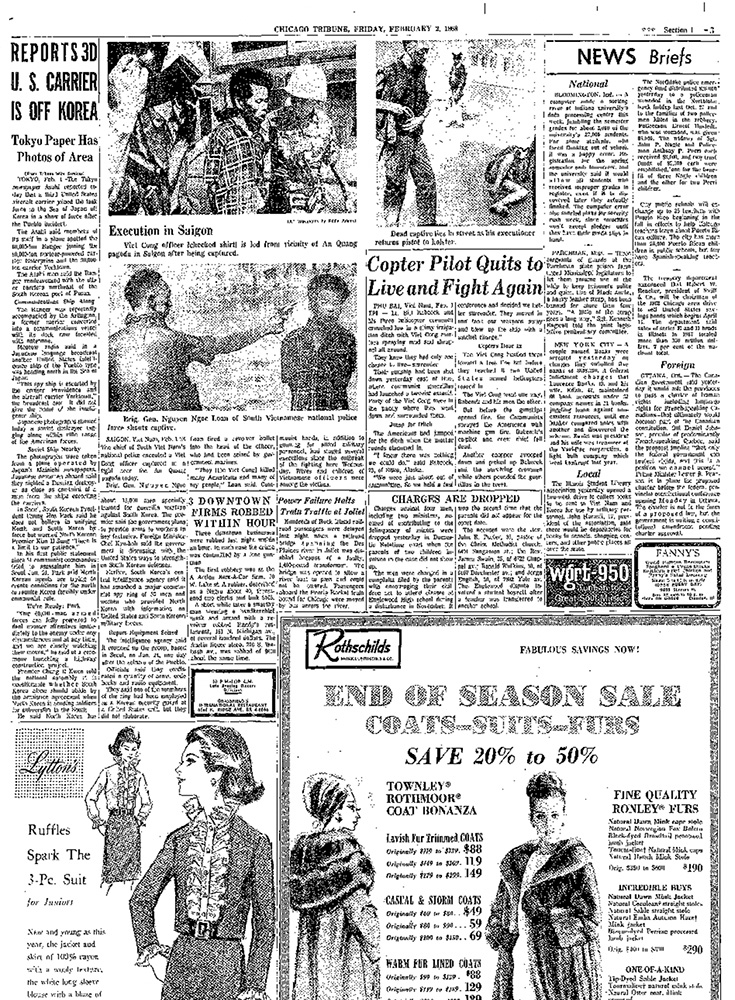
Three pages from newspapers that printed “Saigon Execution.”

Figure 25. Saigon Execution in the New York Times (A1 and A3) and the Los Angeles Times, February 1, 1968. Document Photographs. Newspaper Archives Online. Eddie Adams.

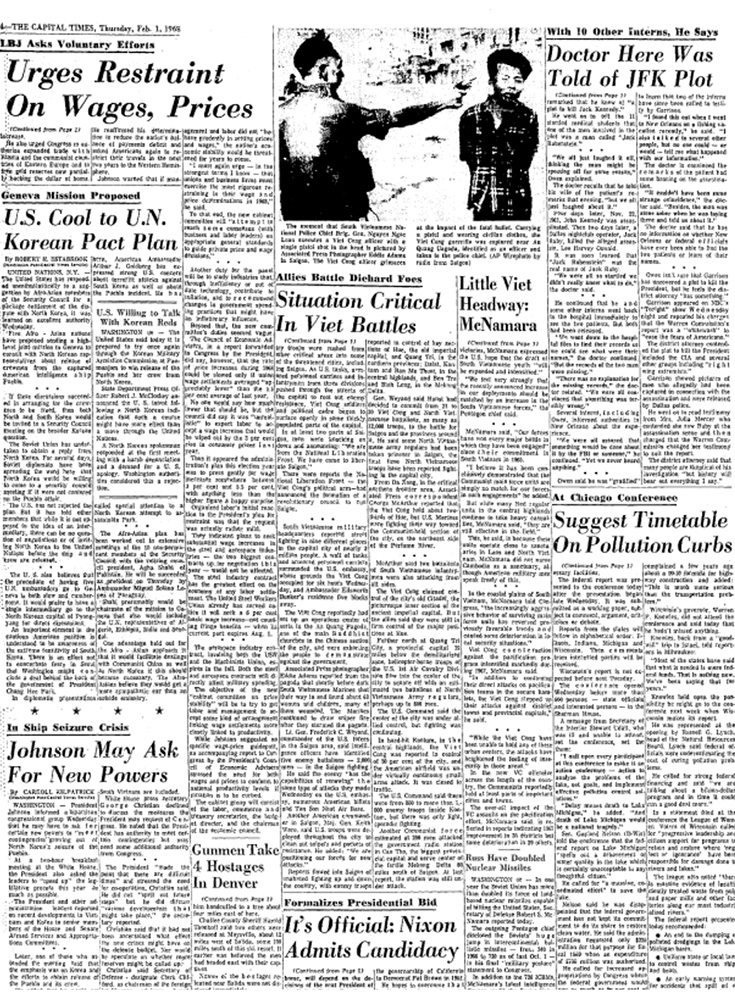
Iconic photographs from the Vietnam War fit that aspect of the catalytic function almost perfectly. While the Vietnam War was not the first war to be photographed, its pictures have had impressive staying power. Photographs of the Vietnam War circulated widely and left their traces all over US public life, making them perfect cases for catalytic visual rhetoric. Saigon Execution stands out even among the era’s iconic photographs. Eddie Adams was an Associated Press(AP) photographer, so every newspaper that was subscribed to the AP had access to his photograph as soon as AP editors approved it. At least twelve newspapers published it on February 2, and all but one of these placed it on the front page. Those twelve included many of the country’s most prominent newspapers: the New York Times, the Washington Post, the Boston Globe, the Chicago Tribune, and the Los Angeles Times. NBC and ABC both aired the still photograph on the evening news that day—though NBC later also ran its own footage.10 Newsweek featured the photograph in its February 12 issue. When TIME ran the photograph on February 9, 1968, the segment’s author was already declaring Adams’ photograph the image of the Vietnam war.11 The photograph won Adams a Pulitzer Prize as well as numerous other awards.

With those circulation statistics, it is safe to say that most U.S. viewers encountered Saigon Execution in the weeks after Lem’s death. Those viewers’ responses—often quick and visceral—suggest the photograph was instantly indicting. Three of the six letters to the editor of the New York Times published on February 7 address the Adams photograph. All are outraged, declaring that the photograph shows a “summary lynching,” that it “should be enough to turn the stomach of even a sanctimonious hawk,” and the US effort is bound to fail in the face of such blatant “criminality."12 Like all three of those letters, contemporaneous and recent commentary on Saigon Execution suggest that the photograph provoked judgment not only of individual brutality but also, and more forcefully, of the United States’ complicity in it.

Three pages from newspapers that printed “Saigon Execution.

Figure 26. Saigon Execution in the Chicago Tribune, the Racine Journal-Times, and the Capitol Times in Madison, Wisconsin. February 1 and February 2, 1968. Document photographs. Newspaper Archives Online. Eddie Adams.

The public response to Saigon Execution poses something of a chicken and egg problem, though: was the photograph influential because it sparked public condemnation of the war or did existing public condemnation of the war give the photograph its power? Most discussion of the photograph—popular and scholarly—presumes the former, but scholars have also shown that context is crucial and thoroughly determines photographic effects.13 When rhetoricians emphasize public circulation as evidence of influence, we must also treat the ways that circulation itself acts rhetorically—lending persuasive power to the things that circulate.14 Photographs like Saigon Execution allow rhetoricians to draw useful, multidirectional connections between public circulation and rhetorical effects, positioning the catalytic aspect of the visual as a public force to be reckoned with.

That conflation of the powerful picture and its public circulation also point to a key limitation of the catalytic frame: an emphasis on publicity too easily equates visibility with power and influence and, simultaneously, treats lack of publicity as an indicator of invisibility and debility. The strong theory of rhetoric, in which rhetorical action is defined in terms of a concrete, direct, and documentable effect, leads rhetoricians working with the catalytic functions of the visual to sometimes credit pictures with a public force that they do not quite merit, at least not on their own. Thus, publicity both lends power to and complicates our understanding of the visual’s catalytic functions.

The Visual as Convicting


What the public circulation of Saigon Execution produced—if critical sources are to be believed—was conviction. A U.S. public already ill at ease with the cost of the Vietnam War saw the street-side execution as yet more evidence of the war’s immorality. Barbie Zelizer notes that the photograph’s image of “certain death” pushed audiences to “engag[e] around an unsettled public event.”15 Because in the picture, Lem’s death is inevitable but not yet complete, Zelizer argues, the photograph was particularly powerful for getting US viewers to consider consequences, to assign blame, and to take action--in other words, to engage with the photograph as forensic rhetoric. Extending Zelizer’s argument, we suggest that the “visual subjunctive” of that moment opened the possibility that Loan could have made a different choice and, in parallel, that the powers perpetuating the War could also have chosen differently.

Three photographs, including one before and after “Saigon Execution,” used together in a New York Times story.

Figure 27. Saigon Execution series in The New York Times, A 12, February 2, 1968. Document photograph. Newspaper Archvies Online. Eddie Adams.

More generally, photographs showing atrocity—war, genocide, massacre—are ground zero for the popular and scholarly expectation that pictures spark judgment. Malcolm Browne’s “burning monk” photograph, Michelle Murray Yang suggests, not only shocked audiences in the US, but also “depleted American support for Diem” and ultimately catalyzed the American-led coup against him.16 “Image Events,” Kevin DeLuca has repeatedly argued, communicate the work of social protest visually, delivering gut punches of judgment in a highly mediated world.17 Analyzing the visual “purification” of the New Orleans Superdome following Hurricane Katrina, Daniel Grano and Kenneth Zagacki, track contradictory convictions that simultaneously indict the most vulnerable and demand national atonement for their suffering.18 For these and many other rhetoricians viewing pictures through the catalytic function, those images serve as evidence. Brought before viewers, they lead, inevitably, to conclusions about right and wrong, guilt and innocence. The pictures, as evidence, are presented as having clear and direct effect. They do the work of conviction, even when they are placed within larger cultural, political, or historical contexts.

Even when rhetoricians track a picture’s failure to make change, our framing questions often take a catalytic orientation, asking ‘why did this picture fail to inspire action?’ Seeing images that we presume ought to have power, most viewers begin from a presumption of exigence and see failure to catalyze as a mystery to uncover. Such reactions ultimately reinscribe the centrality of the catalytic functions for visual rhetoric and the deep-seated presumption that powerful pictures ought to lead to powerful reactions.

By all accounts, Adams’ photograph left viewers no question about its power. In the stories told about its effects, Saigon Execution not only strengthened public conviction against the Vietnam War but also convicted General Loan in the court of US public opinion. While it is impossible to untangle the photograph’s effects on public opinion from the larger context of the war, there is certainly evidence that Saigon Execution wielded influence on viewers and became a focal point for their judgments. Letters to the editor—even those that objected to publication of the graphic photograph—acknowledged its power and used the photograph to comment on the progress of the war. Newspapers returned repeatedly to the photograph as they grappled with the war’s morality. Awards committees recognizing the photograph included its presumed effects in their accounts of its quality. And the Red Cross reported gaining traction in its negotiations with the South Vietnamese government following the wide circulation of the photograph. As we note above, the photograph added to growing public distrust of the war’s prosecution. In a retrospective on the photograph, TIME notes that “freezing the moment of Lem’s death symbolized for many the brutality over there, and the picture’s widespread publication helped galvanize growing sentiment in America about the futility of the fight.”19 Hal Buell, the AP photography director who made the decision to release the picture told NBC in 2018, “the image had an impact, and its impact was felt by those people who were on the fences [about the war].”20 Repeatedly and across contexts, people lent the photograph persuasive power and credited it with changing public sentiment.

This assessment, again, relies on a “strong” theory of rhetoric that emphasizes the force of individual rhetorical objects and places them at the center of rhetorical analysis. Well into the twentieth century, this orientation toward rhetoric persisted as influential if not dominant. The idea of the rhetorical situation, for example, presumes that persuasion happens at the confluence of an audience, a need, and any relevant constraints.21 Get the formula right, and the rhetor’s purpose can be accomplished.

More recent rhetoricians have mostly moved away from such confidence in the individual act, rejecting what David Zarefsky termed the “hypodermic needle” theory of persuasion in which a dose of rhetoric leads to demonstrable effects.22 Instead, as scholars across a wide range of rhetorical subfields have noted, context and condition have everything to do with what any individual persuasive effort might accomplish and, ultimately, ought to be the focus of rhetoricians’ critical and practical work.23 And yet, though rhetoricians working with visual objects are as steeped in that reorientation as any of our peers, the strong theory of rhetoric remains seductive for rhetorical analysis of pictures, perhaps because it aligns with Western cultural assumptions about their power. While not every piece of visual rhetoric scholarship relies on the strong theory of rhetoric, work appealing to the catalytic function of the visual consistently does. When photographs like Adams’s are positioned historically and politically within larger contexts, the catalytic frame encourages rhetoricians to treat those powerful pictures as prime pieces of evidence, as visual condensation points.

Even when visual rhetoric scholars are careful to balance the immanent power of the picture with attention to more capacious contexts, our descriptions of those pictures frequently position them as transparent agents of conviction. We articulate details of form and content as directly linked to meaning and effect: this color, that framing, this symbol are evidence supporting our argument. We attribute agency to visual elements: the direct gaze of subjects calls viewers to account, an indirect gaze allows us to view undisturbed; color choices spark specific feelings; cropping and framing direct our attention and prevent us from having certain reactions. The close cropping of Saigon Execution featured in the newspapers, in this vein, might be said to accentuate conviction as it zeroes viewers’ attention on Loan’s act and Lem’s death. Zelizer’s opening analysis of the photograph takes this approach: Loan “almost offhandedly” puts his pistol to Lem’s head, and his “stiff posture suggested an almost contemptuous disregard for what he was about to do.”24 Anyone familiar with photography knows that what the split-second shutter captures and what fluid movement shows are different. Perhaps Loan did feel contempt for Lem, but reading the frozen moment as clear evidence of feeling presumes that the catalytic frame is photography’s natural paradigm; that pictures convict as part of their basic function. That assertion, however, cannot be fully supported by what we know about rhetoric’s always attenuated, always contextualized strength.

Ascribing the force of conviction primarily to the content and form of the photograph—its powerful framing, enhanced by cropping and its perfect timing—overstates the force of the photograph qua photograph. Catalytic reactions always involve multiple elements. The components of the catalyst never act in isolation. The strong theory of rhetoric may make for engaging analyses, but it ultimately does a disservice to our ability to understand the catalytic rhetorical functions of the visual if it leads us to draw straight lines from rhetorical action to rhetorical conviction. Those lines must, instead, be complicated and situated. We, concur with Caitlin Bruce, in "Visual Rhetoric in Flux," her dialogue essage with Cara Finnegan, when she quips "I love to engage a virtuosic critical reading as much as the next person—it's fun to see someone really good do it really well—but it feels too disconnected from those notions of specificity and fluidity [that come from deep attention to context], I confess I get a bit grouchy."25 In other words, the straight lines between object and effect need to be complicated and situated if we are to understand the visual's catalytic work. Any conviction that results must be understood as a product and process of rhetoric.

The Visual as Risky


If Adams’ photograph was inextricably linked to public consequences, it also had personal consequences. Lingering with those personal consequences illuminates another aspect of the catalytic function of the visual: the rhetor’s lack of control over it. Saigon Execution made General Loan notorious. He eventually emigrated to the United States but was dogged by public outrage inspired by the photograph. People recognized him and took it on themselves to hold him accountable for his extralegal act. Adams publicly expressed regret about the image, writing in TIME years later that “two people died in that photograph…I killed the general with my camera.”26 Even if Loan was never charged with or convicted of war crimes, the photograph served as sufficient evidence for many. Being visible in that moment of crisis put Loan’s life and livelihood at risk.

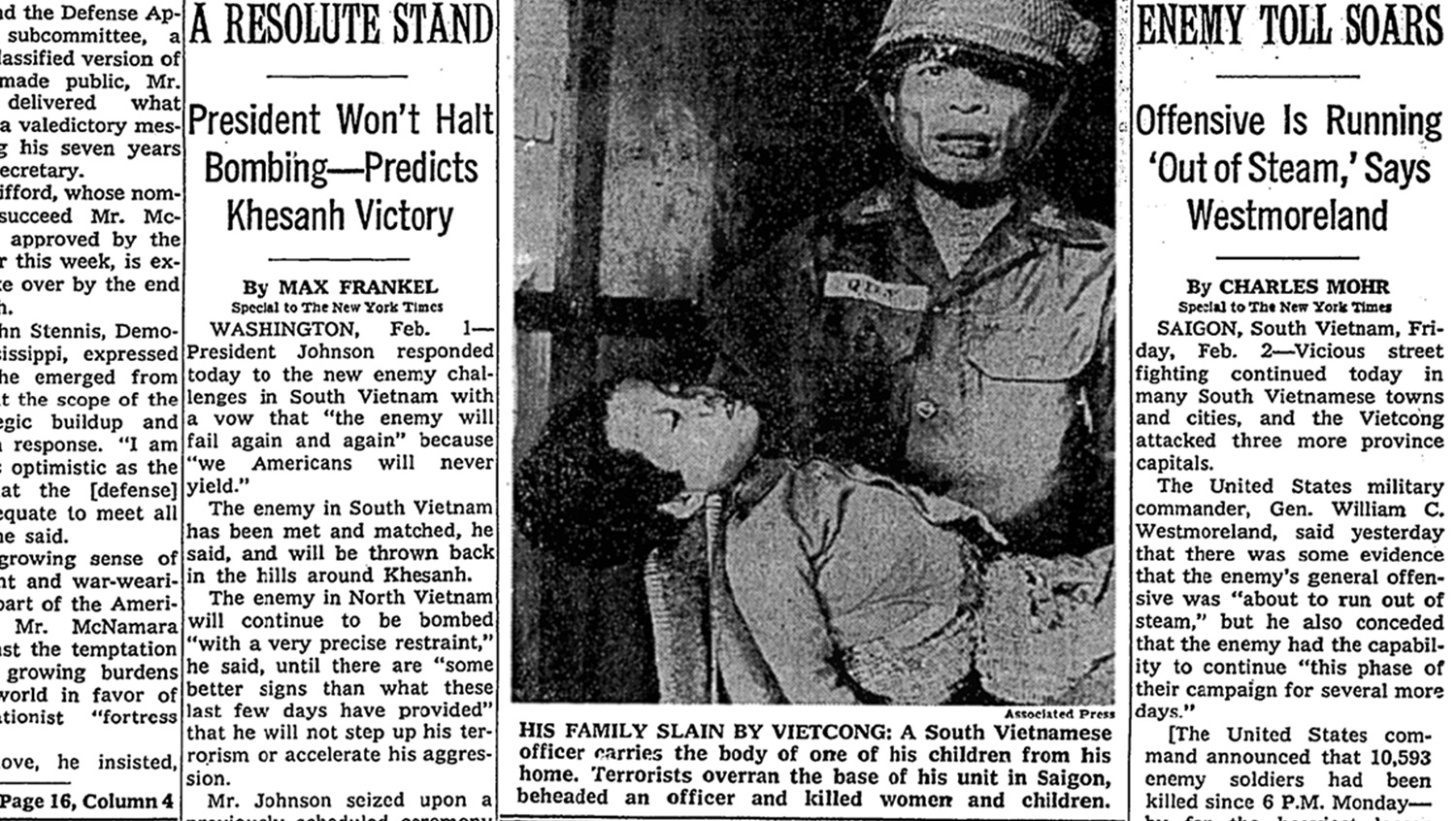
Risk is the flip side of the visual’s catalytic power: if the visual invites judgment, there is always a risk that the judgment will go awry. Neither image makers nor those who deploy images can control where they go, how they are perceived, or how others will take them up.27 This riskiness was a concern for AP editors who, when releasing Adams’s image, also sent a photograph of a South Vietnamese officer carrying the body of one of his children killed by the Viet Cong. The editors aimed to control judgment by providing an “‘atrocities-on-both-sides’ balance.”28 However, AP editors ultimately left “the choice of whether and how to use the photographs” to the newspapers and magazines.29 Those venues, almost unanimously, chose to publish only Adams’s photograph. Similarly, editors could not then control how readers might use the photographs when they viewed them from within their own contexts and needs.

Figure 28. The "balance" photograph in the New York Times: A1. February 1, 1968. Document Photograph. Newspaper Archvies Online.

Reflecting on his photograph’s effects, Adams repeatedly acknowledged visual risk. The quotation that opens this section, “Still photographs are the most powerful weapons in the world,” continues: “People believe them; but photographs do lie, even without manipulation. They are only half-truths.”30 His words corroborate the ubiquitous assumption that photographs hold power, but raise the question of how impossible it is to contain that power. They also suggest that the assumption of pictorial power can be self-fulfilling: Because pictures are assumed to hold such power, they do, in fact, sometimes accrue a version of it. They guide judgment and they carry out judgements. But those judgements are not consistent, fair, or controllable. Being visible puts people and ideas at risk. Scholars who focus on visibility and invisibility,31 who ponder aesthetic effects,32 who track unexpected outcomes,33 who study racialization and vision34 and who follow misleading pictures35 all give us insight into this aspect of catalytic riskiness. In the catalytic frame, that riskiness is typically located in the visual object under analysis. However, as we will explain in chapter 5, that risk of misapprehension is also built into the habituated physiology of sight itself.

Adams’ photograph was risky in the days and months immediately following its publication—having uncontrollable implications for US policy, for Loan’s life, and for Adams’s biography. In later years, the photograph’s convictions likewise spiral out of control. It recurs today in conservative commentary aimed at convicting liberal failures and in untold memes, where Loan and Lem’s positions are taken over by the pepper spray cop, President Obama, Rodrigo Duterte, a “Feminazi,” Barbie, Ken, or even Mckayla Maroney. In an irony appropriate to our argument here, one edited version shows Loan shooting Lem with a camera rather than a pistol. It is risky to shoot and to be shot. It is also risky to presume that the evidence we find in a photograph is the only evidence available or that the evidence we find will also be found by others.

Five memes of “Saigon Execution.”

Figure 29. Memes of Saigon Execution. Image. DeviantArt and KnowYourMeme.

Within and beyond rhetorical studies, analyses of Vietnam-era photography often carry the implicit presumption that the photographs themselves—in both intention and content—were anti-war. Yet by his own account, Adams felt that Loan’s actions were justified and whatever concerns he felt about the prosecution of the war were at least somewhat balanced by his professional investments in it. In subsequent interviews, he presented the war in relatively neutral terms, not vociferously critiquing it, as his pictures are presumed to have done. When we see pictures as catalytic and invoke the forensic, we often presume that pictures take sides—that they are arguments in favor of one position and against another. That presumption of directional judgment ultimately limits our understanding of how photographs, pictures, and the visual itself function catalytically. When working with the catalytic function, then, rhetoricians must locate its work in the confluence of experiences, venues, and uses to which a visual object adheres rather than locating it within the picture itself.

The Slide Toward Iconoclasm


In their influential essay, “Sighting the Public,” Cara Finnegan and Jiyeon Kang taught rhetorical scholars to recognize iconoclasm not only in “gross” circumstances of iconophobic dismissal but also in “subtle” contexts where seemingly productive scholarly orientations toward pictures mask iconophobic presumptions. The risk of both “gross” and “subtle” iconoclasm is exacerbated when we are dealing with iconic photographs like Adams’s Saigon Execution. Such photographs, even more than others, are ripe for presumptions about pictures’ power that slide easily from celebration to fear. Iconic pictures quickly become detached from context and circulate on their own, with their own stories, aggregating force and seeming to set their own agenda. What DeLuca and his co-authors have celebrated as the immanent power of photographs to transcend context also means that they are susceptible—even in our analyses—to iconoclasm’s “will to control images and visions.”36

In her analysis of Saigon Execution in About to Die, Zelizer shares an extended quotation from Adams, allowing him to set the story of the photograph. Yet Adams’s own narrative has clearly been reshaped by his photo’s iconicity. Adams’s words present the iconic photograph as standing alone, momentary and kairotic. He explains,

Half a block away I noticed a policeman and an airborne trooper bring a suspect out of a building. He was a small barefooted man in civilian clothes with his hands tied behind his back. As they walked toward me, I ran up just to be close by in case something happened. I felt it was just another ordinary street arrest since they were heading for a nearby jeep. My friend Vo Su kept filming as we saw another policeman on my left start walking toward the prisoner. He was drawing his pistol from its holster. I thought he was going to threaten the V.C. so I framed my 35mm rangefinder camera, making the picture as I heard a gunshot.37

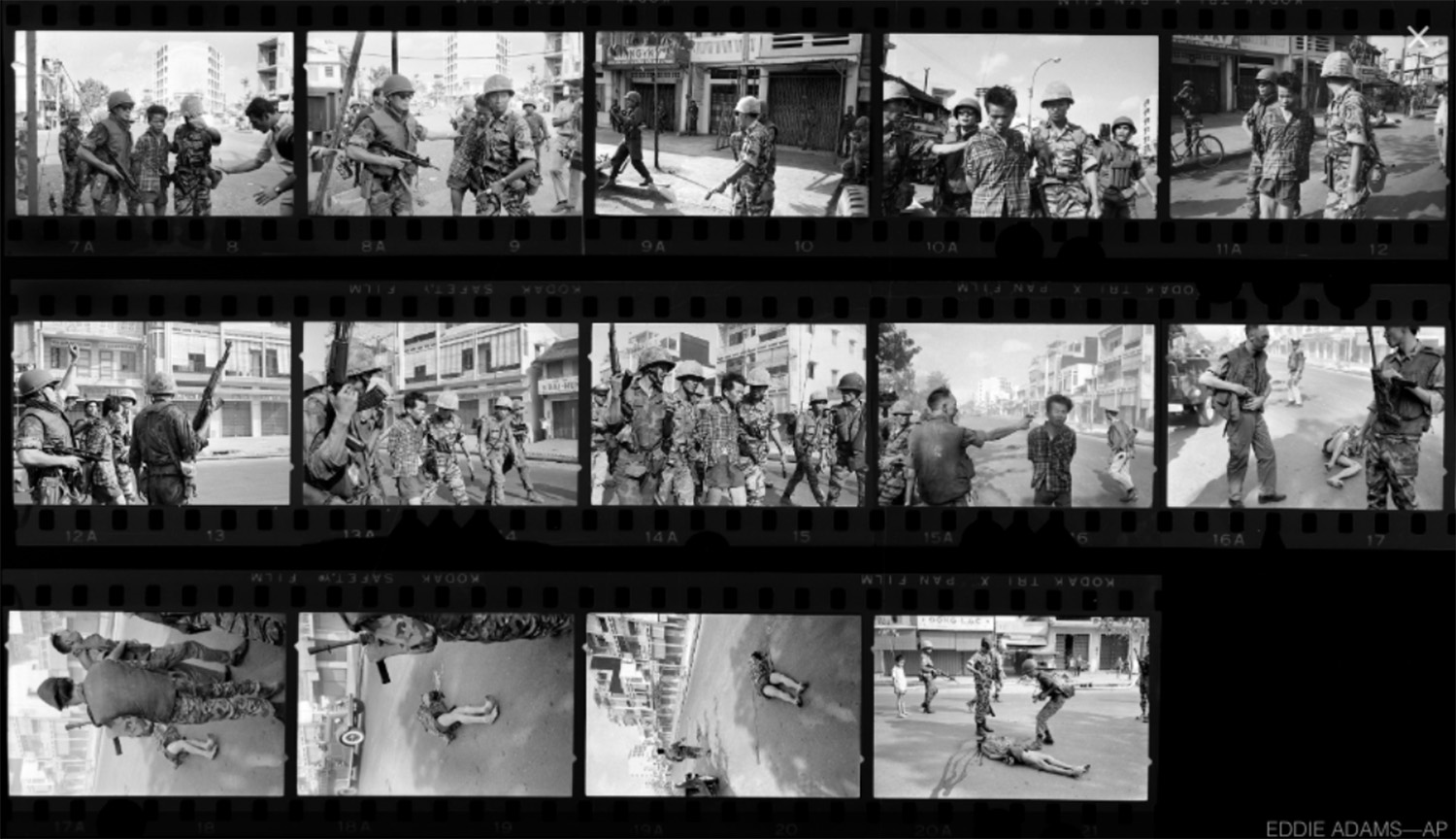
While Adams’ account—given several years after the fact—may be generally accurate, it contains a curious omission. On February 2, 1968, at least two major US newspapers carried not only Saigon Execution but two other photographs by Adams—one taken as Lem was led from the building where he was captured and the other showing Lem fallen to the ground while Loan holsters his pistol. Indeed, Adams actually took at least fourteen pictures that morning. But in his description, the iconic photograph stands alone—a timely accomplishment.

Fourteen photograph negatives that include moments before and after the “Saigon Execution” photograph.

Figure 30. Contact sheet for Saigon Execution. Photographs taken before and after. February 1, 1968. Briscoe Center for American History. University of Texas at Austin. Eddie Adams.

There is no particular harm in Adams’s erasure of the additional photographs, but their loss is nevertheless telling. It was still a stroke of kairotic fortune that Adams happened to click his shutter just at the moment of the shot. But, how strong must the allure of the iconic image be in order to secure such forgetfulness about the other photographs he took in the lead up and aftermath of the iconic moment? Adams himself seemed to forget the sequence of events. Subsequent accounts—for example, the photo’s description on TIME’s 100 Photos collection—likewise omit it. Within a few decades the luminescence of the iconic image was so powerful that the other photographs had fully faded from public view and from private and public memory, leaving Adams’s masterful, fortunate timing as part of the story of the photograph’s influence. As one particular photograph comes to serve as a catalytic fulcrum, it exercises its own control over other images and over public perspective. The catalytic force of the visual, in other words, includes a tendency for pictures to continue accruing and appropriating force. It not only relies on strong theories of rhetoric, it also feeds them.

When we set pictures up as powerful sources of judgment and as catalysts for action, then we are equally set up to reject them when they fail to produce those ends. And we are equally set up to fear them when they prompt problematic judgements or inspire troubling action. The catalytic frame for the rhetorical force of the visual, in other words, is a frame fraught with iconoclasm. The love of, desire for, and belief in pictures is, on its flip side, the fear of images.

If recent years’ iconic images and forceful pictures have taught us anything, it is that we need tools for understanding vision’s ability to catalyze judgment without presuming that a given picture will tend toward a single outcome. We first wrote these words in summer 2019. It had been five years since Eric Garner's, Michael Brown's, and Tamir Rice’s deaths were captured in photographs and videos. A huge movement emerged in response to those murders, yet it would be naive to attribute either the movement or significant social change to the pictures themselves. The pictures of their murders—and the many similar pictures circulated in subsequent years—have been, almost without exception, insufficient to convict any of their killers. Likewise, in summer 2018, photographs of immigrant children in cages briefly sparked outrage in the United States, but even years later, family separation remained an active policy, and the horrific conditions in detention facilities on the US-Mexico border continued. For the most part, the conviction produced by photographs is short-lived and both white supremacy and nationalist border policies prove beyond the capacity of catalytic pictures to uproot.

Though these instances of clear cause and effect are few and far between, many rhetoricians still want pictures to do things and, more to the point, we want them to make us do things. And so, we turn consistently to the forensic, the catalytic when we go looking for visual rhetoric. The search for the powerful pictures that define the catalytic function of the visual—pictures that can definitively be said to have done something—introduces a number of cascading circularities into the study of visual rhetoric. Most notably, it is never entirely clear whether a given picture itself is powerful or whether, having been named as powerful, the picture becomes a reservoir—holding effects that flow around it. And if pictures accrue rhetorical force by circulating widely and being seen repeatedly, then visual rhetoric becomes, inexorably, a discipline attuned to the already powerful. Less noticeable, but equally important, are the circular ways that the strong theory of visual rhetoric determines both what counts as visual rhetoric and who is likely to take it up. One must, after all, be invested in the search for direct effects and definite influence in order to go looking for the sorts of powerful pictures that could have those results. And if one is interested in rhetorics happening outside the halls of power, where pictures might not circulate very far and might rarely be said to have significant effects, then one might not turn to visual rhetoric at all.

The catalytic functions of the visual can tell us a great deal about how viewers relate to pictures and what rhetors across a range of political movements do with pictures. Ironically, though, despite the fact that they tend to highlight individual visual objects, on their own, these catalytic functions cannot fully reveal what makes powerful pictures so apparently powerful. The ultimate lesson of the catalytic functions, in other words, is to help us recognize the assumptions that make some pictures seem powerful and then to situate those risky, convicting, public pictures within the relations and contexts from which they emerge and into which they will eventually disappear.


Footnotes

  1. See Robert S. Cathcart, “Movements: Confrontation as Rhetorical Form,” in Readings on the Rhetoric of Social Protest, 95–103, 2006; Edward P.J. Corbett, “The Rhetoric of the Open Hand and the Rhetoric of the Closed Fist,” College Composition and Communication 20, no. 5 (December 1969): 288–96; Franklyn S. Haiman, “The Rhetoric of the Streets: Some Legal and Ethical Considerations,” Quarterly Journal of Speech 53, no. 2 (1967): 99–114; Robert L. Scott and Donald K. Smith. “The Rhetoric of Confrontation," Quarterly Journal of Speech 55, no. 1 (1969): 1–8; Donald Smith, “The Rhetoric of Riots,” Contemporary Review 213 (1968): 178–84.

  2. Davi Johnson, “Martin Luther King Jr.’s 1963 Birmingham Campaign as Image Event,” Rhetoric and Public Affairs 10, no. 1 (2007): 1–26.

  3. Robert L. Scott, “Diego Rivera at Rockefeller Center: Fresco Painting and Rhetoric,” Western Journal of Speech Communication 41, no. 2 (1977): 70–82.

  4. Christine Harold and Kevin Michael DeLuca, “Behold the Corpse: Violent Images and the Case of Emmett Till.” Rhetoric & Public Affairs 8, no. 2 (2005): 263–86.

  5. Johnson, “Martin Luther King Jr.”

  6. Chrita J. Olson, “On the Border Family Separation Crisis: There Are Enough Pictures Now,” Reading The Pictures (blog), June 18, 2018.

  7. Even Maureen Goggin’s work on samplers and Diane Hope’s study of snapshots—though they treat ostensibly more private visual forms—draw attention to the public forces circulating through private contexts. Maureen Daly Goggin, Women and the Material Culture of Needlework and Textiles, 1750-1950 (New York: Routledge, 2016); Diane S. Hope, “Memorializing Affluence in the Postwar Family: Kodak’s Colorama in Grand Central Terminal (1950-1990),” in Visual Communication: Perception, Rhetoric, and Technology (New York: Hampton Press, 2005): 91–110.

  8. Cara A. Finnegan, “The Critic as Curator,” Rhetoric Society Quarterly 48, no. 4 (August 8, 2018): 405–10; Christa J. Olson, American Magnitude: Hemispheric Vision and Public Feeling in the United States. (Columbus, OH: Ohio State University Press, 2021).

  9. As we argue in chapter 6, however, such velocity has obscured other pervasive effects of the visual. Kevin Michael DeLuca and Jennifer Peeples, “From Public Sphere to Public Screen: Democracy, Activism, and the ‘Violence’ of Seattle,” Critical Studies in Media Communication 19, no. 2 (June 2002): 125–51.

  10. Adams and an NBC cameraman both caught Lem’s death on film but NBC only realized later that it had footage of the same event. For more, see Barbie Zelizer, About to Die: How News Images Move the Public. (New York: Oxford University Press, 2010).

  11. Robert Hamilton, “Image and Context: ‘Execution of a VC Suspect,’” Vietnam Images: War and Representation, ed. Jeffrey Walsh and James Aulich (New York: St. Martin’s Press, 1989), 178.

  12. S. Kenneth Nelson, "Letter to the Editor," New York Times, February 7, 1968; Herman Seid, “Letter to the Editor," New York Times, February 7, 1968. https://www.nytimes.com/1968/02/07/archives/execution-of-vietcong.html

  13. See, for example, William O. Saas and Rachel Hall, “Restive Peace: Body Bags, Casket Flags, and the Pathologization of Dissent,” Rhetoric & Public Affairs 19, no. 2 (Summer 2016): 177–208.

  14. See, for example, Cara A. Finnegan and Jiyeon Kang, “‘Sighting’ the Public: Iconoclasm and Public Sphere Theory,” Quarterly Journal of Speech 90, no. 4 (November 2004): 377–402; Laurie E. Gries, Still Life with Rhetoric: A New Materialist Approach for Visual Rhetorics (Logan: Utah State University Press, 2015); Olson, American.

  15. Zelizer, About to Die, 230.

  16. Michelle Murray Yang, “Still Burning: Self-Immolation as Photographic Protest," Quarterly Journal of Speech 97, no. 1 (February 2011): 4.

  17. Kevin Michael DeLuca, Image Politics: The New Rhetoric of Environmental Activism. (New York: Routledge, 2009); DeLuca and Peeples, “From Public”; John W. Delicath and Kevin Michael DeLuca, “Image Events, the Public Sphere, and Argumentative Practice: The Case of Radical Environmental Groups,” Argumentation and Advocacy 17 (2003): 315–33.

  18. Daniel A. Grano and Kenneth S. Zagacki, “Cleansing the Superdome: The Paradox of Purity and Post-Katrina Guilt,” Quarterly Journal of Speech 97, no. 2 (2011): 201-23.

  19. “Saigon Execution.” TIME 100 Photos: Most Influential Images of All Time, TIME, 2016. Accessed February 24, 2022.

  20. Jennifer Peltz, “In an Instant, Vietnam Execution Photo Framed a View of War," Associated Press, January 28, 2018.

  21. Lloyd F. Bitzer, “The Rhetorical Situation,” Philosophy & Rhetoric 1 (1968): 1–14.

  22. David Zarefsky, “Presidential Rhetoric and the Power of Definition,” Presidential Studies Quarterly 34, no. 3 (2004): 607.

  23. See, for example, Lee Artz, "Speaking the Power of Truth: Rhetoric and Action for Our Times," in Activism and Rhetoric: Theories and Contexts for Political Engagement, ed. JongHwa Lee and Seth Kahn (New York: Routledge, 2010): 159-72; Maurice Charland, "Constitutive Rhetoric: The Case of the Peuple Québécois," Quarterly Journal of Speech 73, no. 2 (May 1987); Diane Davis, Inessential Solidarity: Rhetoric and Foreigner Relations (Pittsburgh, PA: University of Pittsburg Press, 2010); Amos Kiewe and Davis W. Houck, eds., The Effects of Rhetoric and the Rhetoric of Effects: Past, Present, Future (Columbia: The University of South Carolina Press, 2015).

  24. Zelizer, About to Die, 226.

  25. Caitlin Frances Bruce and Cara A. Finnegan, "Visual Rhetoric in Flux: A Converstaion," Rhetoric & Public Affairs 24, no. 1-2 (2021): 92-93.

  26. Eddie Adams, “Eulogy: General Nguyen Ngoc Loan,” TIME, July 27, 1998.

  27. Johnson names this point as a fundamental aspect of DeLuca’s “image event,” which, we suggest, is one of the most widely-used rubrics for visual rhetoric scholarship treating the catalytic functions of the visual. Johnson, “Martin Luther King Jr’s.”; DeLuca, Image Politics.

  28. Peter Braestrup, Big Story: How the American Press and Television Reported and Interpreted the Crisis of Tet 1968 in Vietnam and Washington (Novato, CA: Presidio Press, 1994), 199.

  29. Braestrup, Big Story, 199.

  30. Adams, “Eulogy.”

  31. Dan Brouwer, “The Precarious Visibility Politics of Self‐stigmatization: The Case of HIV/AIDS Tattoos,” Text and Performance Quarterly 18, no. 2 (April 1998): 114–36; Rubén Casas, "Maps as Inscription of Power: Imposing Visibility on New York’s 'Shadow Transit,'" Rhetoric Review, 40, no 2 (2021): 167-182.

  32. Joshua Trey Barnett, “Toxic Portraits: Resisting Multiple Invisibilities in the Environmental Justice Movement,” Quarterly Journal of Speech 101, no. 2 (April 3, 2015): 405–25; Jennifer Peeples, “Toxic Sublime: Imaging Contaminated Landscapes,” Environmental Communication 5, no. 4 (December 2011): 373–92.

  33. James Fredal, “Herm Choppers, the Adonia, and Rhetorical Action in Ancient Greece,” College English 64, no. 5 (May 2002): 590–612.

  34. Lisa A. Flores, “Between Abundance and Marginalization: The Imperative of Racial Rhetorical Criticism,” Review of Communication 16, no. 1 (January 2, 2016): 4–24; Ersula J. Ore, Lynching: Violence, Rhetoric, and American Identity. (Jackson: University Press of Mississippi, 2019).

  35. James J. Kimble, “Rosie’s Secret Identity, Or, How to Debunk a Woozle by Walking Backward through the Forest of Visual Rhetoric,” Rhetoric & Public Affairs 19, no. 2 (2016): 245–74; James J. Kimble and Lester C. Olson, “Visual Rhetoric Representing Rosie the Riveter: Myth and Misconception in J. Howard Miller’s ‘We Can Do It!’ Poster,” Rhetoric & Public Affairs 9, no. 4 (Winter 2006): 533–69.

  36. Finnegan and Kang, “Sighting,” 377.

  37. Eddie Adams, qtd. in Barbie Zelizer, About to Die, 225-26.